
c
- HS Code, when applicable.
This information is important because international freight costs are not determined only by the purchase price.
Weight, volume, packaging, cargo characteristics and transportation method can all affect the final logistics cost.
The process becomes more complicated when a company purchases from several suppliers.
One supplier may finish production today, another next week, while a third may be located in a completely different Chinese city.
This is where a consolidation warehouse becomes valuable.
2. The China warehouse: the central point before international shipping
After the goods are ready, suppliers can deliver the cargo to a logistics warehouse in China.
The warehouse acts as a controlled point where shipments from different suppliers can be received, identified, checked and prepared for international transportation.
For example, an Armenian company may purchase products from suppliers in Guangzhou, Shanghai and Ningbo.
Instead of arranging a separate international shipment for every supplier, the goods can be collected and consolidated through a designated warehouse.
This can make the logistics process more organized and may allow the importer to optimize transportation costs.
The warehouse stage can also be useful when suppliers have different production schedules.
Instead of shipping every small batch immediately, a business can coordinate shipments around a planned departure.
3. Consolidation: turning multiple supplier shipments into one logistics flow
Consolidation is one of the most useful solutions for businesses that purchase from multiple Chinese suppliers or whose cargo does not fill an entire container.
With LCL—Less than Container Load—different shipments can be transported within the same container, subject to the logistics provider’s procedures and available service.
This means a company does not necessarily need to reserve an entire container when its cargo is smaller than a full container.
Consolidation can be especially useful when:
- you purchase from several suppliers;
- orders are ready at different times;
- the shipment does not require a full container;
- you import goods regularly;
- you want to optimize transportation costs;
- you need a more flexible supply chain.
Proper cargo identification is essential at this stage.
Every shipment should be clearly marked and recorded so that packages from different suppliers and purchase orders can be correctly identified.
4. LCL or FCL: which solution is right for your business?
For commercial imports, two common options are LCL and FCL.
LCL (Less than Container Load) means that your shipment occupies only part of a container.
FCL (Full Container Load) means that the shipment uses a full container under the applicable transportation arrangement.
The choice should not be based on volume alone.
Businesses should consider shipment frequency, cargo characteristics, delivery requirements, supplier locations and total logistics cost.
If your business regularly imports large quantities and the shipment volume is sufficient for a full container, FCL may be an appropriate solution.
If you purchase smaller quantities from several suppliers, LCL may offer greater flexibility.
The objective is not simply to choose the cheapest option. The objective is to choose the transportation model that fits the business’s supply chain.
5. Choosing the international transportation method
The transportation method depends on the cargo, urgency, volume, budget and available routes.
Sea freight
Sea freight is commonly considered for larger shipments where delivery speed is less critical than cost efficiency.
For Armenia-bound cargo, the logistics chain can involve a regional seaport followed by inland transportation to Armenia.
This makes route planning especially important.
Road freight
Road transportation can be used for suitable China-to-Armenia logistics routes and may provide a balance between transit time and cost.
For businesses that need a faster alternative to sea freight but do not necessarily require air freight, road transportation can be considered as part of the overall logistics plan.
Rail freight
Rail solutions can also be available within China-Europe and broader regional logistics networks, depending on current routes and service availability.
Rail can be considered when a business is looking for an alternative between traditional sea and air solutions.
Air freight
Air freight is generally used when speed is the primary priority.
It can be suitable for urgent, high-value or relatively small shipments where faster delivery justifies the higher transportation cost.
There is no single transportation method that is best for every business.
The right option depends on your cargo and your commercial priorities.
6. Documentation should be prepared before the shipment leaves China
Documentation is one of the most important parts of international freight.
Depending on the cargo and import requirements, Armenian importers may need commercial invoices, packing lists, transport documents, contracts or other commercial documentation. Certain products may also require certificates, licenses, permits or other supporting documents.
This is why documentation should be reviewed before the cargo leaves China.
The product description and customs classification should also be checked carefully.
The HS Code is particularly important because customs classification can influence applicable duties, restrictions and documentation requirements.
A logistics process should therefore include both physical cargo planning and document planning.
7. The cargo arrives in Armenia
Once international transportation is completed, the cargo arrives in Armenia and proceeds through the applicable customs procedures.
For commercial imports, customs declarations can be submitted electronically, while the exact documentation requirements depend on the type of goods and the import circumstances.
The information in the customs documents should correspond to the actual shipment.
Product descriptions, quantities, values, package numbers and other relevant information should be accurate and consistent.
Incorrect or incomplete information may lead to additional checks, delays or additional procedures.
For this reason, customs planning should begin before the cargo reaches Armenia—not after it arrives.
8. Customs clearance and final delivery
After the customs process is completed, the cargo can be delivered to the company’s warehouse, production facility, store or another designated location.
At this point, the logistics process reaches its final stage.
For a business importer, the value of a logistics partner is therefore not limited to moving cargo from point A to point B.
A complete service can coordinate the entire chain:
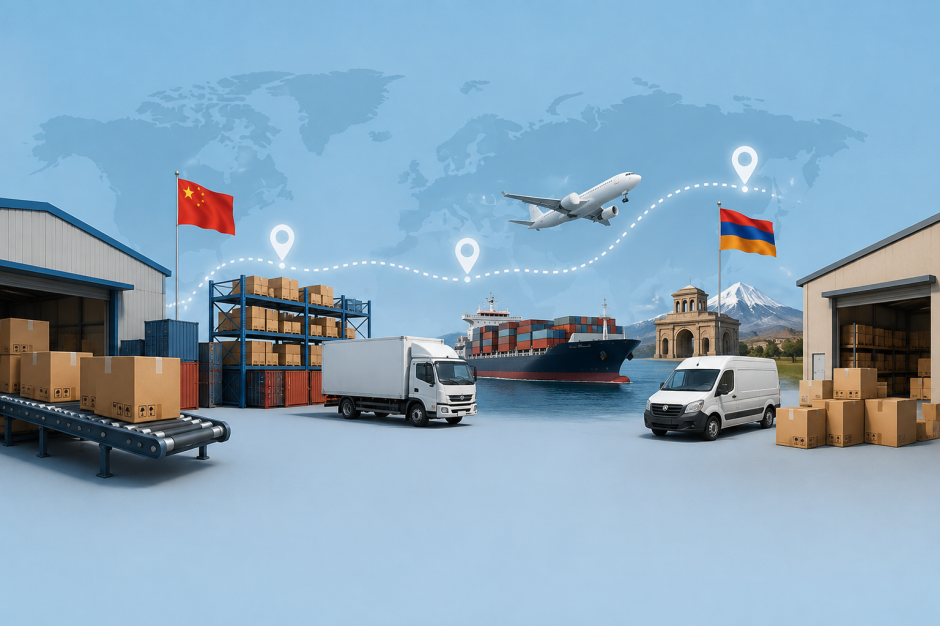
Supplier → Pickup → China Warehouse → Consolidation → International Freight → Armenia → Customs → Final Delivery
This approach can reduce the number of parties the business has to coordinate independently.
9. Why managing the entire supply chain matters
If every stage is managed separately, the importer may need to communicate with multiple suppliers, warehouse operators, freight companies, customs specialists and local delivery providers.
This creates additional coordination work.
The business may constantly need answers to questions such as:
Where is the supplier’s cargo?
Has it reached the warehouse?
Have all packages arrived?
Has the shipment been consolidated?
When is the next departure?
Which documents are required?
When will the cargo arrive in Armenia?
Who will coordinate customs clearance?
For companies that import regularly, centralized logistics management can make the supply chain easier to monitor.
The objective is to turn multiple independent actions into one organized process.
10. What should businesses calculate before importing from China?
One of the most common mistakes is looking only at the international freight price.
The actual logistics cost can include several components:
- pickup from the supplier;
- transportation inside China;
- warehouse handling;
- consolidation;
- international transportation;
- cargo handling;
- customs-related services;
- customs duties and taxes where applicable;
- final delivery in Armenia.
Transit time should also be included in the calculation.
A lower transportation price may not be the most efficient choice if the shipment arrives too late and interrupts the company’s inventory cycle.
On the other hand, choosing the fastest option for every shipment may unnecessarily increase logistics costs.
The right solution balances four major factors:
cost + transit time + cargo safety + predictability.
11. Building a reliable China–Armenia supply chain
A reliable import process should not start when the cargo is already at the warehouse.
It should begin when the purchase order is being planned.
Before placing an order, the business should understand:
- where the supplier is located;
- how the cargo will reach the China warehouse;
- how many suppliers will be involved;
- whether consolidation is required;
- which transportation method is appropriate;
- what documents will be needed;
- what customs requirements may apply;
- where the cargo will be delivered in Armenia.
This approach allows logistics to become part of procurement planning rather than an afterthought.
Importing commercial goods from China to Armenia is a complete logistics chain, not a single transportation operation.
The process can be structured as:
Supplier → China Warehouse → Consolidation → LCL/FCL → International Transportation → Armenia → Customs Clearance → Business Address
Every stage can influence the final cost, delivery time and reliability of the supply chain.
For Armenian businesses working with Chinese suppliers, an experienced logistics partner can help coordinate the different stages and create a more transparent and predictable import process.
The goal is simple: your supplier operates in China, your business operates in Armenia, and the logistics process connects the two sides efficiently.
