
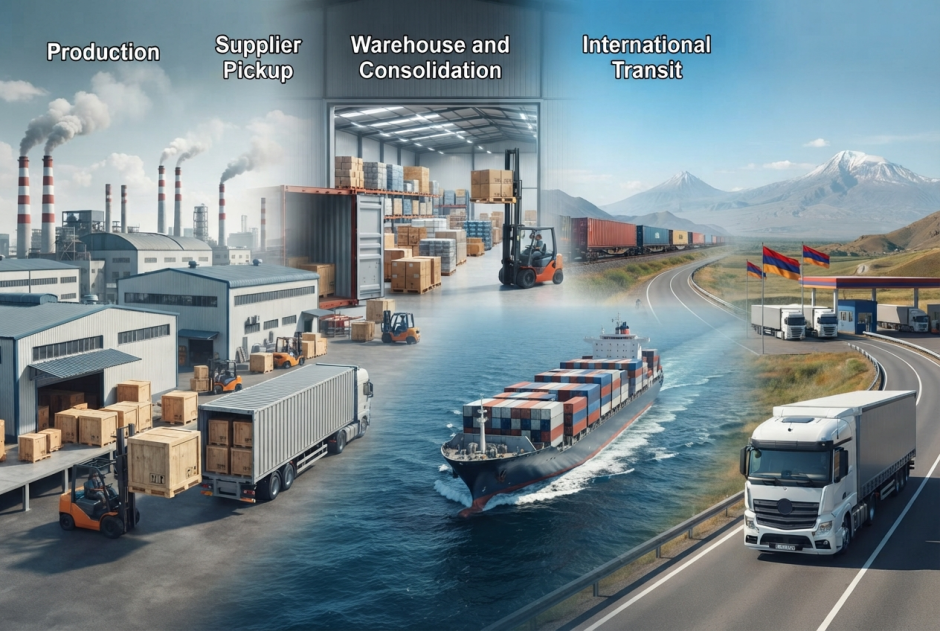
For any business relying on Chinese manufacturing, time equals money and market competitiveness. Yet, the initial 30-day delivery estimate promised by suppliers frequently stretches into two or three months of waiting. Where do those weeks vanish, and why does the logistics chain fail? The import process consists of multiple critical stages, each harboring significant risks of time loss.
1. Production: The First Broken Promise
Everything starts at the factory. Suppliers often quote optimal production timelines without accounting for seasonal shifts, Chinese New Year, Golden Week, or raw material shortages. If a factory takes on larger orders, yours might get pushed to the end of the queue. Additionally, back-and-forth revisions during sample approval can add another one to two weeks.
2. Supplier Pickup: Domestic Logistics Traps
Having goods ready does not mean they are moving toward Armenia. Transporting goods internally from the factory to an export warehouse in China is frequently bogged down by bureaucracy, internal transport shortages, and heavy traffic. If documentation or labeling fails to meet regulatory standards, local authorities can halt transit immediately.
3. Warehouse and Consolidation: Waiting for LCL Space
If you are importing in smaller batches (Less than Container Load – LCL), your cargo must be gathered at a consolidation warehouse. Time is lost here as warehouses wait until a container is completely filled with other orders. A one-to-two-week delay at this stage is common, especially if your cargo requires special packaging or palletization.
4. International Transit: Navigating Transport Arteries
The route from China to Armenia is long and crosses multiple international borders. Whether using road transport, rail, or a multimodal approach, risks multiply:
-
Border crossing queues (such as at Georgian-Russian or Armenian-Georgian checkpoints).
-
Weather disruptions (snowstorms in mountain passes, severe road conditions).
-
Intermediate customs inspections in transit countries.
5. Armenia and Customs Clearance: The Final Mile
Once cargo arrives in Armenia, the customs clearance phase begins. Most delays here stem from incorrect or incomplete paperwork—missing certificates of origin, mismatched HS codes, or customs valuation disputes requiring extra verification.
Supply Chain Optimization Strategies
-
Plan orders well in advance, keeping Chinese holiday calendars in mind.
-
Work with trusted logistics partners who maintain their own warehouse infrastructure in China.
-
Rigorously audit all documentation before dispatching the cargo.
