International trade creates new opportunities for businesses, allowing them to expand their supplier networks, enter new markets, and increase their competitiveness. However, successful international trade depends not only on product quality and pricing but also on how efficiently goods are transported.
Choosing the wrong transportation method can lead to additional costs, delivery delays, and disruptions to business operations. That is why every company needs to understand the main types of international freight transportation, their advantages, and their specific applications.
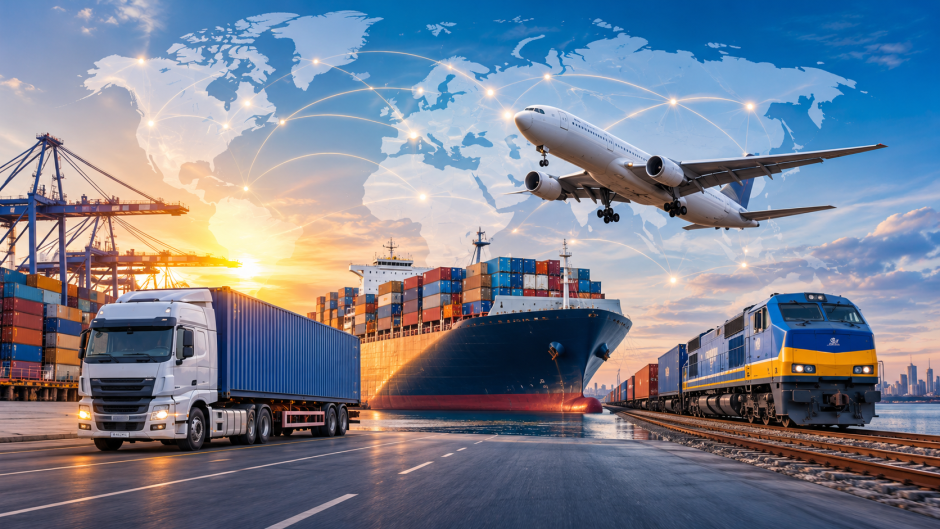
Today, businesses can choose between sea, road, air, rail, and multimodal transportation depending on cargo characteristics, weight, volume, delivery deadlines, and budget.
In this article, we explore the main types of international freight transportation and explain how to choose the most suitable option for your business.
1. Main Types of International Freight Transportation
International logistics involves several transportation methods, each with its own advantages, limitations, and applications.
The main types of freight transportation include:
- Sea Freight.
- Road Freight.
- Air Freight.
- Rail Freight.
- Multimodal Transport.
Each option is suitable for different business requirements. Choosing the right solution means considering not only transportation costs and delivery speed but also the overall efficiency of the supply chain.
2. Sea Freight: An Efficient Solution for Large Shipments
Sea freight is one of the most widely used methods of international cargo transportation. It is particularly suitable for heavy, bulky, and large-volume shipments when the shortest possible delivery time is not the main priority.
Sea transportation connects different continents and international seaports, making it an essential part of global trade.
It is especially popular among businesses importing goods from China, India, South Korea, and various European countries.
Main Types of Sea Freight
FCL (Full Container Load)
FCL means that an entire shipping container is allocated to one customer’s cargo.
This option is suitable for businesses transporting large quantities of goods or requiring a dedicated container for their shipments.
Advantages of FCL:
- Full use of container capacity.
- No need to consolidate the cargo with other customers’ shipments.
- Convenient transportation of large quantities of goods.
- Better control over shipment planning.
LCL (Less than Container Load)
When a shipment is not large enough to fill an entire container, LCL transportation can be a more practical solution.
With LCL, shipments from different customers are consolidated into one container.
This option is particularly beneficial for small and medium-sized businesses that regularly import goods but do not require a full container.
Advantages of LCL:
- Payment based on the volume occupied by your cargo.
- No need to pay for an entire container.
- Flexibility to import smaller quantities of goods.
- More efficient inventory management.
For example, if your company imports construction materials, lighting equipment, or furniture components from China and the shipment volume is relatively small, LCL transportation may be a cost-effective choice.
When Should You Choose Sea Freight?
- When transporting large or heavy shipments.
- When reducing transportation costs per unit is important.
- When delivery deadlines allow for longer transit times.
- When regularly importing goods from international markets.
It is important to remember that the total delivery time depends not only on the sea transit itself but also on port congestion, transit procedures, and subsequent inland transportation.
3. Road Freight: Flexibility and Better Control
Road freight is an essential part of international logistics. It involves transporting goods by trucks and is particularly effective between countries with developed road transportation networks.
For Armenia, road freight plays an important role in the transportation of goods from Europe and other regions.
Advantages of Road Freight
- Flexible route selection.
- Door-to-door delivery possibilities.
- Transportation of different cargo sizes and types.
- More flexible delivery planning.
- Suitable solutions for both full truckloads and smaller shipments.
FTL (Full Truck Load)
FTL means that a truck is allocated to one customer’s shipment.
This option is suitable for large shipments, industrial products, construction materials, and other high-volume cargo.
LTL (Less than Truck Load)
LTL transportation involves combining shipments from different customers into one truck.
This allows businesses to transport smaller quantities of goods without paying for the entire truck.
It is particularly useful for companies that receive regular shipments but do not have enough cargo to fill a complete vehicle.
When Should You Choose Road Freight?
- When transporting goods from European countries.
- When flexible delivery schedules are required.
- When the cargo volume does not justify a full sea container.
- When door-to-door transportation is needed.
A well-planned route and an experienced freight forwarding company can help improve supply chain efficiency and optimize transportation costs.
4. Air Freight: Speed as a Competitive Advantage
When time is critical for a business, air freight can be the most suitable transportation option.
Goods are transported by aircraft, significantly reducing international delivery times.
Air freight is particularly suitable for high-value, urgent, and relatively small shipments.
Advantages of Air Freight
- Fast international delivery.
- Shorter transit times over long distances.
- Convenient transportation of high-value goods.
- Faster replenishment of warehouse inventory.
- Reduced risk of production or business disruptions caused by urgent delivery delays.
When Should You Choose Air Freight?
Air transportation is a suitable option when:
- Goods need to be delivered as quickly as possible.
- Delivery delays could result in financial losses.
- Small but high-value products are being transported.
- Warehouse inventory needs urgent replenishment.
- Market demand requires rapid deliveries.
However, air freight is generally more expensive than sea freight and many road transportation options.
When calculating air freight costs, it is important to consider not only the actual weight of the shipment but also its volumetric weight.
5. Rail Freight: An Alternative Logistics Solution
Rail freight plays an important role in international logistics. It is particularly relevant on routes with suitable railway infrastructure.
This transportation method can be effective for moving heavy and large-volume shipments over long distances.
Advantages of rail freight include:
- The ability to transport large quantities of cargo.
- Access to established transportation routes.
- Competitive costs on certain routes.
- Convenient planning for large shipments.
However, the availability of rail freight depends on the route, railway infrastructure, border crossings, and additional transportation stages.
When organizing shipments to Armenia, the possibilities of available transit routes must also be considered.
6. Multimodal Transportation: Combining Different Modes of Transport
Multimodal transportation involves moving a shipment using two or more different modes of transport.
For example, cargo may be transported from China by sea to a European port and then delivered to Armenia by road.
This approach allows businesses to combine the advantages of different transportation methods.
Advantages of multimodal transportation:
- Flexibility to combine different routes.
- Optimization of logistics costs.
- A balance between delivery time and transportation expenses.
- The ability to serve complex geographical destinations.
This option is particularly important for businesses working with suppliers in multiple countries and managing complex supply chains.
7. EXPRESS and ECONOM Transportation: Choosing Between Time and Cost
In addition to choosing the transportation method, businesses need to determine the most appropriate service level.
Companies often face a common decision: pay more for faster delivery or choose a more economical option with longer transit times.
EXPRESS and ECONOM services provide different solutions to this challenge.
EXPRESS Transportation
EXPRESS services are designed for businesses that prioritize delivery speed.
For example, the estimated delivery time for EXPRESS road freight from Europe to Armenia may be 8–10 days, with an approximate variation of ±2 days depending on the route and logistics conditions.
This option is suitable for:
- Urgent shipments.
- Fast warehouse replenishment.
- Maintaining uninterrupted production processes.
- Time-sensitive customer orders.
ECONOM Transportation
ECONOM services are designed for businesses looking to reduce logistics costs and willing to plan for longer delivery times.
For example, ECONOM sea freight from China to Armenia can be organized with a guaranteed delivery period of 40 days, subject to the service terms and conditions.
This option is suitable for:
- Planned imports.
- Large-volume shipments.
- Reducing transportation expenses.
- Goods that do not require urgent delivery.
The choice between EXPRESS and ECONOM should be based not only on transportation costs but also on sales cycles, inventory levels, and the company’s financial capabilities.
8. Out-of-Gauge Cargo Transportation (OOG)
Not every shipment can be transported using standard containers or regular trucks.
Industrial equipment, manufacturing machinery, large metal structures, and other oversized cargo require specialized logistics solutions.
Special container types used for OOG transportation include:
- Open Top – containers with an open roof, suitable for cargo that requires top loading.
- Flat Rack – platform containers with open sides and no roof, designed for oversized and heavy cargo.
These solutions make it possible to transport shipments that cannot fit into standard containers because of their dimensions or structural characteristics.
When organizing OOG transportation, it is important to evaluate the cargo weight and dimensions, loading and unloading requirements, and technical restrictions along the route.
9. How to Choose the Right International Freight Transportation Method
Selecting the right transportation method requires evaluating several important factors.
1. Cargo Weight and Volume
The first step is to determine the exact weight, volume, and dimensions of the shipment.
LCL or LTL transportation may be suitable for smaller shipments, while FCL or FTL may be more appropriate for larger volumes.
2. Delivery Time
How quickly does your business need to receive the goods?
If speed is the priority, consider air freight or EXPRESS services. If delivery can be planned in advance, sea freight or ECONOM services may provide a more cost-effective solution.
3. Logistics Budget
Transportation costs should be evaluated as a whole.
It is important to consider not only the main freight rate but also potential additional expenses, including:
- Loading and unloading charges.
- Warehousing costs.
- Terminal handling charges.
- Customs clearance-related expenses.
- Cargo insurance, where required.
- Final-mile delivery costs.
4. Nature of the Cargo
Some goods require specialized transportation conditions.
For example, oversized industrial equipment, fragile products, and temperature-sensitive shipments must be transported using appropriate vehicles and equipment.
5. Frequency of Shipments
If your company imports goods regularly, developing a long-term logistics strategy is essential.
For recurring shipments, businesses can compare different routes, consolidate cargo, and select solutions that make logistics expenses more predictable.
10. Why Is It Important to Choose an Experienced Freight Forwarding Company?
International freight transportation is more than simply moving goods from one country to another. It is a complex process involving multiple organizational and technical stages, from route planning to final cargo delivery.
An experienced freight forwarding company can help businesses:
- Select the most suitable transportation method based on cargo characteristics.
- Find the right balance between delivery costs and transit times.
- Organize full-load and consolidated shipments.
- Coordinate international transportation routes.
- Reduce the likelihood of operational errors and delays.
- Improve supply chain management.
For B2B companies in particular, working with a reliable logistics partner is essential. The right partner understands business requirements and provides more than transportation services — it offers comprehensive logistics solutions.
11. CLT: Your International Logistics Partner
Clever Logistics & Transport (CLT) is an international freight transportation company with more than 15 years of industry experience.
CLT organizes cargo transportation from China, Europe, South Korea, India, and other destinations to Armenia, providing logistics solutions for shipments of different sizes and types.
The company’s main services include:
- Sea Freight – FCL and LCL transportation.
- Road Freight – full truckload and less-than-truckload transportation.
- Air Freight – for shipments where delivery speed is a priority.
- EXPRESS and ECONOM Services – tailored to business delivery deadlines and budget requirements.
- OOG Transportation – oversized cargo transportation using Open Top and Flat Rack containers.
CLT operates its own cargo consolidation lines on the China–Armenia and Europe–Armenia routes and also organizes transportation from South Korea and India.
For ECONOM sea freight from China, CLT offers a guaranteed 40-day delivery period. The estimated transit time for EXPRESS road freight from Europe is 8–10 days, with an approximate variation of ±2 days.
CLT’s approach is based on selecting logistics solutions that meet each business’s requirements, taking into account cargo volume, destination, delivery deadlines, and costs.
The company serves the B2B segment, supporting importers, exporters, manufacturers, and trading companies.
The Right Logistics Choice Is the Foundation of Business Efficiency
Efficient international freight transportation directly affects a company’s profitability, supply chain stability, and competitiveness.
Sea freight is suitable for large shipments, road freight provides flexibility for European routes and regional deliveries, air freight is ideal for urgent shipments, while multimodal solutions make it possible to combine different transportation methods efficiently.
However, there is no single transportation method that works equally well for every business. The right decision depends on product characteristics, delivery deadlines, logistics costs, and business development goals.
A reliable logistics partner will help you choose not just a transportation route, but the most efficient solution for your business.
Contact CLT specialists to receive professional advice and find the most suitable international freight transportation solution for your cargo.
Clever Logistics & Transport — Your business logistics: faster, more profitable, and more controllable.
