
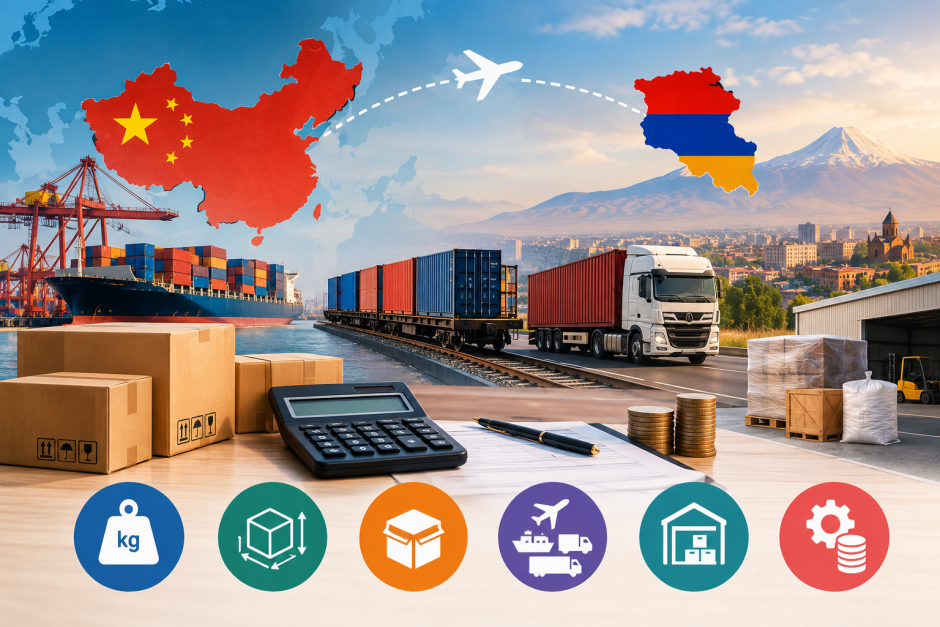
Importing goods from China to Armenia can help businesses expand their product range, access new suppliers and improve their competitiveness. However, the supplier’s quoted price is only one part of the total cost. To determine the actual cost of importing goods, businesses must also consider international freight, cargo weight and volume, packaging, warehousing, customs charges, documentation and local delivery.
Many importers begin with a simple question: How much does it cost to ship one kilogram from China to Armenia? In reality, the final shipping price depends on several factors. Two shipments with the same actual weight may have different transportation costs because they occupy different amounts of space, require different packaging or use different transportation methods.
This article explains how shipping costs from China to Armenia are calculated, which additional expenses importers should consider and how businesses can optimize their logistics costs without compromising reliability or cargo safety.
1. What Determines Shipping Costs from China to Armenia?
The cost of freight transportation is generally determined by the cargo’s characteristics, the selected route, the transportation method, the required delivery time and any additional services.
The main factors include:
- Actual cargo weight.
- Total shipment volume and package dimensions.
- Number of packages and packaging type.
- Product category and special handling requirements.
- Transportation method: road, sea, air or multimodal freight.
- Collection of goods from the supplier in China.
- Warehousing and cargo consolidation.
- Loading, unloading and cargo handling.
- Delivery schedules and route conditions.
- Insurance, customs clearance and other additional services.
For this reason, providing only the cargo’s weight may not be sufficient to obtain an accurate quotation. A freight forwarder needs the shipment’s main specifications and a clear understanding of which services should be included.
2. Actual Weight vs. Volumetric Weight
Actual weight and volume are among the most important factors affecting international freight costs.
Actual weight is the physical mass of the cargo, generally measured in the condition in which it is handed over to the carrier.
Volumetric weight is a calculated measurement that reflects the amount of space a shipment occupies. It is particularly important for air freight and other transportation services where cargo dimensions affect the use of available capacity.
Consider two shipments:
- Shipment A weighs 100 kg and occupies 0.5 cubic meters.
- Shipment B weighs 100 kg and occupies 2 cubic meters.
Although both shipments have the same actual weight, Shipment B takes up significantly more space. As a result, their transportation costs may differ.
How Is Volumetric Weight Calculated?
For air freight, a commonly used formula is:
Volumetric weight (kg) = length × width × height (cm) ÷ volumetric divisor.
For example, suppose a package measures 100 × 80 × 60 cm. If the applicable divisor is 6,000, the calculation is:
100 × 80 × 60 ÷ 6,000 = 80 kg.
If the package’s actual weight is 45 kg, its volumetric weight in this example is 80 kg. Depending on the carrier’s terms, the chargeable weight may be based on the greater of the actual and volumetric weights.
The divisor can vary depending on the carrier, route and service type. Road, sea and multimodal shipments may use different pricing methods, including weight, cubic meters, loading space or vehicle capacity.
Tip for importers: Before confirming an order, ask your supplier for the actual weight, dimensions of each package, total number of packages and total volume of the fully packed shipment. This information helps you obtain a more accurate freight quotation before purchasing the goods.
3. How Does the Transportation Method Affect the Final Price?
The most suitable shipping method depends on shipment size, product type, budget and the required delivery time.
Road and Multimodal Freight
Road and multimodal transportation can be suitable for businesses looking to balance shipping costs and delivery schedules.
The final price depends on the route, transit countries, transportation arrangements, cargo consolidation and associated handling operations.
These options may be considered for commercial shipments of furniture, building materials, lighting equipment, household products and other goods, provided the selected service meets the cargo’s transportation requirements.
Sea Freight
Sea freight is often considered for large shipments and goods that do not require urgent delivery. Under suitable conditions, it can be a cost-effective option for businesses importing substantial quantities.
However, the total cost of sea freight may extend beyond the ocean freight rate. Importers should clarify whether port charges, cargo handling, storage, inland transit and final delivery are included in the quotation.
Air Freight
Air freight is generally suitable for urgent, relatively small or high-value shipments when speed is a priority.
Its transportation cost is often higher than that of slower alternatives. Businesses should therefore evaluate not only the freight rate but also the commercial value of receiving the goods sooner.
LCL vs. FCL: Which Option Should You Choose?
LCL (Less than Container Load) means that a shipment occupies only part of a container and is consolidated with cargo belonging to other customers.
FCL (Full Container Load) refers to using an entire container for a shipment under the agreed transportation terms.
LCL can be suitable for small and medium-sized shipments that do not justify booking an entire container. However, the calculation should also account for consolidation, warehouse handling and cargo separation.
FCL may be more efficient for larger volumes, but importers should compare the cost of a full container with other available options and assess how efficiently the container will be used.
The best option depends on the shipment’s actual dimensions, route and applicable rates rather than the service label alone.
4. How Packaging Affects Shipping Costs
Packaging protects goods against damage, but it also influences the shipment’s total volume.
If a supplier uses oversized boxes or packs goods inefficiently, the shipment occupies more space than necessary. This can increase transportation costs, particularly when charges are based on volumetric weight or cubic meters.
On the other hand, reducing packaging excessively can increase the risk of breakage, damage and financial losses.
To optimize packaging costs:
- Request the final dimensions of the packed goods.
- Ask whether box dimensions can be reduced safely.
- Consider consolidating smaller packages when permitted.
- Use appropriate protective materials for fragile products.
- Ensure that packaging meets transportation and storage requirements.
For furniture, lighting fixtures, building materials and other bulky products, efficient packaging can make a meaningful difference to the overall logistics budget.
5. Warehousing and Cargo Consolidation in China
Many importers purchase goods from multiple suppliers. Their orders may be located in different Chinese cities and become ready for shipment at different times.
In these situations, businesses may need to collect goods from suppliers, transport them to a warehouse, store them temporarily, inspect packages, consolidate orders and prepare a combined shipment for international transportation.
Potential costs include:
- Transportation from suppliers to a warehouse.
- Warehouse receiving and cargo handling.
- Storage charges after any free-storage period.
- Repacking or additional protective packaging.
- Consolidation of multiple orders.
- Transportation from the warehouse to the departure point.
Combining multiple orders may simplify logistics and can sometimes reduce overall costs. However, savings are not guaranteed. The location of suppliers, cargo readiness dates and warehouse service rates must all be considered.
Before confirming purchases, importers should clarify the conditions and costs of cargo collection, storage and consolidation in China.
6. Customs Duties and Other Import Expenses
International freight charges and customs payments are separate components of the total import cost.
Customs charges depend on the product’s classification, customs value, origin and applicable regulations. Depending on the product category, import duties, value-added tax (VAT), excise taxes or other legally applicable charges may be payable.
Additional expenses may include:
- Customs declaration and brokerage services.
- Required certificates, permits and conformity documents.
- Inspections or additional checks, where applicable.
- Terminal handling and storage.
- Cargo insurance.
- Unloading and domestic transportation within Armenia.
The customs value is not necessarily limited to the amount paid to the supplier. It is determined under the applicable customs valuation rules, including relevant costs where required.
Before importing, businesses should verify the correct product classification and applicable requirements with a customs specialist or the relevant competent authority.
Important: A freight quotation does not automatically include customs duties, taxes, brokerage or all expenses incurred in Armenia. Importers should confirm exactly which services and charges are included before accepting an offer.
7. How to Calculate the Total Landed Cost of Goods in Armenia
For businesses, the key question is not simply how much transportation costs, but how much the goods will cost after reaching Armenia and completing the necessary procedures.
The total landed cost calculation may include:
- The purchase price of the goods.
- Transportation from the supplier to a warehouse or departure point in China.
- Warehousing, inspection and consolidation.
- International freight charges.
- Insurance, where applicable.
- Customs duties and taxes.
- Brokerage and documentation costs.
- Unloading, storage and domestic delivery in Armenia.
- Other mandatory or contractually agreed expenses.
A Practical Cost Calculation Example
Suppose a business imports a commercial shipment with the following illustrative expenses:
| Expense | Illustrative amount |
|---|---|
| Purchase cost of goods | AMD 1,000,000 |
| Transportation and warehousing in China | AMD 80,000 |
| International freight | AMD 220,000 |
| Insurance and documentation | AMD 20,000 |
| Customs duties and taxes | AMD 180,000 |
| Unloading and domestic delivery in Armenia | AMD 50,000 |
| Total estimated cost | AMD 1,550,000 |
In this example, the total estimated cost is AMD 1,550,000. These figures are illustrative only; they are not current freight quotations or an actual customs assessment for a particular product.
If the shipment contains 500 units, the estimated landed cost per unit would be:
AMD 1,550,000 ÷ 500 = AMD 3,100 per unit.
This example demonstrates why importers should not calculate profitability using only the supplier’s price or the freight rate per kilogram. A realistic cost calculation should include all applicable expenses.
Accounting and tax rules may treat individual expenses differently, so businesses should consult their accountant when determining the official accounting cost and setting selling prices.
8. How to Reduce Shipping Costs from China to Armenia
Reducing logistics expenses does not simply mean choosing the carrier with the lowest quoted price. The goal is to find a solution that balances cost, reliability, delivery time and cargo safety.
1. Calculate shipment volume in advance. Request package dimensions and weight before confirming the order.
2. Compare different logistics solutions. Ask for quotations using available transportation methods and check which services each offer includes.
3. Compare LCL and FCL. Consider consolidated freight for smaller shipments and full-container transportation for larger volumes.
4. Plan purchasing schedules. Where practical, combine orders while accounting for additional storage and consolidation expenses.
5. Optimize packaging. Discuss safe ways to reduce package volume without compromising product protection.
6. Prepare documentation early. Incorrect product descriptions, commercial invoices, packing lists or permits can lead to delays and additional costs.
7. Check what is included in the quotation. Clarify whether collection, storage, consolidation, international transportation, unloading and final delivery are covered.
8. Consider the cost of time. A cheaper but slower shipment may delay sales or disrupt inventory planning. Evaluate the overall commercial impact rather than looking at the freight rate alone.
9. How to Choose a Freight Forwarder for China–Armenia Shipments
A reliable logistics partner should help businesses understand the cost structure and organize transportation according to their requirements.
When selecting a freight forwarder, consider the following:
- Transparency about included and excluded services.
- Accurate cost calculations based on cargo weight, volume and specifications.
- Clear information about routes and estimated delivery times.
- Availability of warehousing and consolidation services.
- Experience handling the relevant type of commercial cargo.
- Effective documentation procedures and customer communication.
- Advance clarification of potential additional charges.
Clever Logistics & Transport (CLT) organizes commercial cargo transportation from China to Armenia, starting from 50 kg. The appropriate logistics solution depends on the cargo’s specifications, weight, volume and required delivery schedule.
To receive a quotation, prepare the main shipment details in advance. This helps the logistics provider assess the shipment and discuss suitable transportation options for your business.
10. What Information Is Needed to Calculate Shipping Costs?
To obtain a more accurate freight quotation, provide the following details:
- Product name and category.
- Total quantity of goods.
- Actual cargo weight.
- Number of packages and dimensions of each package.
- Total volume in cubic meters, if available.
- Supplier’s city or warehouse address in China.
- Expected date when the goods will be ready.
- Required delivery timeframe.
- Whether cargo must be collected from multiple suppliers.
- Any special packaging, insurance or handling requirements.
If some information is not yet available, provide the details you already have and ask the logistics provider what else is required for a final quotation.
Frequently Asked Questions (FAQ)
How much does shipping from China to Armenia cost?
The cost depends on cargo weight, volume, product type, route, transportation method, delivery schedule and additional services. For an accurate quotation, provide the shipment specifications and confirm which services are included.
How do I calculate the total cost of importing goods from China?
Add the purchase price to transportation and storage costs in China, international freight, applicable customs duties and taxes, documentation expenses and domestic delivery in Armenia.
Is shipping calculated by weight or volume?
It depends on the transportation method and the carrier’s pricing rules. Some services use actual or volumetric weight, while others calculate charges based on volume or vehicle capacity.
What is volumetric weight?
Volumetric weight is a calculated measurement that accounts for package dimensions and the space occupied by a shipment. The applicable formula and divisor should be confirmed with the freight forwarder.
How can I reduce shipping costs from China to Armenia?
Compare transportation methods, optimize packaging, consolidate orders where practical, plan shipments in advance and request a transparent quotation that identifies potential additional charges.
Are customs duties included in shipping costs?
Not always. Confirm separately whether the quotation includes customs payments, brokerage services and final delivery within Armenia.
Can I ship a small commercial order from China?
Yes. Consolidated shipping may be suitable for smaller commercial shipments. CLT organizes commercial cargo transportation from China to Armenia starting from 50 kg. The feasibility and price of a particular shipment should be confirmed individually.
Shipping costs from China to Armenia depend on several factors, including cargo weight and volume, packaging, transportation method, warehousing, customs charges and additional services.
Businesses planning imports should evaluate the full landed cost of their goods rather than focusing exclusively on the international freight rate. Preparing shipment information in advance, requesting a transparent quotation and selecting an appropriate logistics solution can help avoid unexpected expenses and support better purchasing and pricing decisions.
Planning to import goods from China to Armenia? Contact Clever Logistics & Transport to discuss your shipment specifications and identify a suitable transportation solution for your business.
