
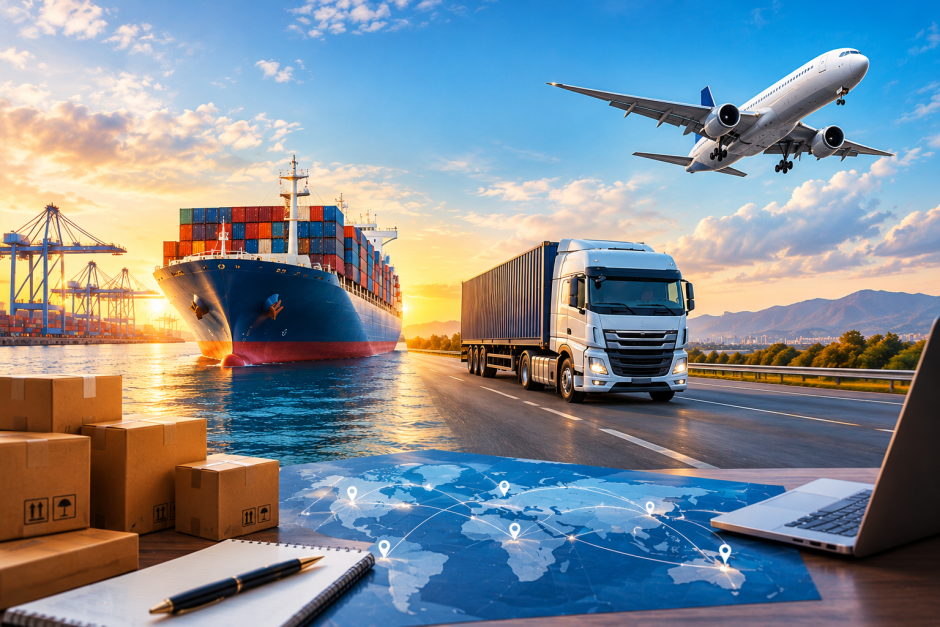
Choosing the right shipping method is an important decision for every business involved in international trade. The transportation method you select affects more than just delivery time. It also influences your total import costs, inventory management, sales planning and overall profitability.
Which option is more cost-effective: sea freight, road freight or air freight? Is the cheapest shipping method always the best choice? And when does it make financial sense to pay more for faster delivery?
The answer depends on several factors, including cargo type, weight, volume, country of origin, delivery deadlines and your company’s business objectives.
In this guide, we compare the three main freight transportation methods, explain their advantages and limitations, and help you determine which solution is best suited to your business.
1. Sea Freight: A Cost-Effective Solution for Large Shipments
Sea freight is widely used in international trade, particularly for transporting large volumes of goods and organizing regular imports from distant markets.
It is a common option for businesses importing products from China, India, South Korea and other countries. Depending on the origin, destination and route, shipments may pass through different seaports before continuing by land to their final destination.
Advantages of sea freight
Lower transportation costs for large shipments. Sea freight is often more economical than air freight when transporting large quantities of goods. It is particularly suitable for construction materials, furniture, industrial equipment, raw materials and wholesale merchandise.
Capacity for large cargo volumes. Businesses can choose Full Container Load (FCL) shipping when they need an entire container or Less than Container Load (LCL) shipping when their cargo shares container space with shipments from other customers.
Better supply chain planning. Companies with predictable demand can place orders in advance, replenish inventory and potentially reduce transportation costs per unit.
Suitable for heavy and bulky goods. Industrial machinery, furniture and large commercial shipments can often be transported efficiently by sea when properly packaged.
What are the limitations?
The main disadvantage of sea freight is its relatively long transit time. The total delivery period depends on vessel schedules, port operations, transshipment, customs clearance and onward transportation.
Additional expenses may include port handling, terminal charges, storage and other logistics services. Therefore, businesses should compare the total logistics cost rather than looking at the basic freight rate alone.
When should you choose sea freight?
Sea freight is often a good choice when:
- You import large or heavy shipments.
- Your business has flexible delivery deadlines.
- Reducing transportation costs per unit is a priority.
- You can plan purchases and inventory replenishment in advance.
- Your cargo can be efficiently packed and transported in containers.
2. Road Freight: Flexibility and a Balance Between Cost and Speed
Road freight plays an important role in transporting goods from Europe, China and other markets to Armenia. Depending on the route, shipments can travel by truck or form part of a multimodal transportation chain.
For many businesses, road freight offers a practical balance between transportation costs and delivery speed, especially when sea freight takes too long and air freight is too expensive.
Advantages of road freight
Flexible routes. Truck transportation can deliver cargo to warehouses, manufacturing facilities and distribution centers, depending on the available route and service conditions.
Suitable for different shipment sizes. Full Truckload (FTL) shipping is suitable for larger consignments, while Less than Truckload (LTL) shipping allows businesses to share available truck space with other shipments.
Effective on suitable European and regional routes. For shipments from Europe to Armenia, road freight can offer a competitive combination of cost, transit time and delivery flexibility.
Convenient warehouse delivery. Properly organized road transportation can reduce the number of intermediate handling operations and simplify delivery to the recipient.
What should businesses consider?
Road freight transit times can be affected by border queues, road conditions, weather, customs procedures and regulations in transit countries.
Before arranging a shipment, it is important to confirm the route, required documentation, border-crossing arrangements and any restrictions that may affect delivery.
When should you choose road freight?
Road freight may be the right option when:
- You import goods from Europe or other markets with suitable land routes.
- You need delivery faster than a typical sea freight service can provide.
- Air freight would be too expensive for your shipment.
- Your cargo needs to reach a warehouse or distribution center.
- You can benefit from FTL or consolidated LTL transportation.
3. Air Freight: When Speed Is the Priority
Air freight is one of the fastest methods of international cargo transportation. It is particularly valuable for businesses that need to replenish inventory quickly, prevent production interruptions or receive products by a strict deadline.
Common applications include electronics, product samples, spare parts, certain medical products and urgent commercial shipments, subject to applicable aviation and cargo regulations.
Advantages of air freight
Fast transportation. Air freight generally reduces the main transportation time considerably compared with sea freight.
Faster inventory replenishment. If a stock shortage could result in lost sales, production downtime or missed contractual deadlines, the additional cost of air freight may be justified.
Suitable for small, high-value shipments. For compact goods with a high value per unit, paying more for faster delivery may be commercially reasonable.
Support for urgent business operations. Companies can use air freight to obtain samples, replacement components and production-critical items when waiting for a slower shipment is not practical.
What are the disadvantages?
Air freight generally has a higher transportation cost than sea freight and many road freight options. Pricing may be based on actual or volumetric weight, according to the carrier’s applicable tariff rules.
Certain goods are subject to restrictions involving packaging, batteries, dangerous goods and other transportation requirements.
Businesses should also distinguish flight time from total delivery time. Cargo preparation, airport handling, customs clearance and final delivery all contribute to the overall transit period.
When should you choose air freight?
Air freight may be the best option when:
- Your delivery deadline is critical.
- Your shipment is relatively small, valuable or urgent.
- The financial impact of a delay exceeds the additional shipping cost.
- You need samples, spare parts or essential production components quickly.
- Your cargo is eligible for air transportation.
4. Sea vs. Road vs. Air Freight: A Comparison
The right choice requires evaluating more than the freight rate. Businesses should also consider total delivery time, additional charges and the potential financial consequences of delays.
| Factor | Sea Freight | Road Freight | Air Freight |
|---|---|---|---|
| Speed | Generally slower | Depends on the route | Generally fastest |
| Transportation cost | Often economical for large volumes | Depends on route and cargo | Generally highest |
| Large shipments | Very suitable | Suitable | Can be expensive |
| Small shipments | LCL consolidation available | LTL consolidation available | Suitable for urgent cargo |
| Main limitation | Longer transit and port operations | Borders and road conditions | Higher cost and cargo restrictions |
This comparison provides general guidance. Actual rates and delivery times depend on the origin, destination, cargo specifications, season and transportation arrangements.
5. How Do Cargo Weight and Volume Affect Shipping Costs?
Cargo weight is only one factor used to calculate transportation costs. The space occupied by the shipment can be equally important.
For example, lightweight but bulky goods may have a high volumetric weight, making air freight more expensive than expected. Two shipments with the same actual weight can have significantly different shipping costs if their dimensions differ.
For sea freight, important factors include the cargo volume in cubic meters (CBM), packaging dimensions and whether FCL or LCL shipping is more appropriate.
For road freight, pricing may depend on the shipment’s weight, volume, loading requirements and the amount of truck space occupied.
To receive an accurate quotation, businesses should prepare the following information:
- Cargo description and product type.
- Number of packages.
- Dimensions of each package.
- Total gross weight and volume.
- Cargo readiness date.
- Supplier’s location and final delivery destination.
Providing complete cargo details helps logistics providers evaluate available routes and recommend suitable transportation options.
6. How to Choose the Most Cost-Effective Shipping Method
The lowest freight rate does not always mean the lowest overall cost.
If a sea shipment arrives after the peak sales season, the initial transportation savings may be outweighed by lost revenue. Conversely, air freight may be unnecessarily expensive for products that can be ordered well in advance.
Consider the following questions before making a decision.
1. How urgently do you need the cargo?
If time is critical, consider air freight. If the delivery deadline is flexible, compare sea and road transportation options.
2. What are the shipment’s weight and volume?
Large shipments may be more economical by sea or through full truckload transportation, depending on the route. Smaller, urgent shipments may justify air freight.
3. What is the cost of a delay?
Consider potential lost sales, production downtime, stock shortages and contractual penalties. A faster shipping method may be worthwhile if it prevents larger financial losses.
4. What is the total landed logistics cost?
Evaluate the main freight charge together with applicable handling, storage, documentation, customs-related, insurance and final-delivery expenses. Confirm which services are included in the quotation and which are charged separately.
5. Can you plan your purchasing schedule in advance?
Businesses with predictable demand can often place orders earlier and choose more economical shipping methods. Urgent replenishment may require a faster alternative.
7. Can Businesses Combine Different Shipping Methods?
Yes. In some situations, combining transportation methods is more effective than relying on a single option.
For example, a company could transport its main inventory shipment by sea and send additional stock by air when demand increases unexpectedly. This approach can help control regular logistics costs while maintaining flexibility during busy sales periods.
Another possibility is multimodal transportation, where different stages of a shipment’s journey use different modes of transport.
However, combining transportation methods requires careful planning of transfer points, schedules, documentation and handling costs. Businesses should evaluate the full logistics chain before selecting this approach.
8. Why Does Choosing the Right Logistics Partner Matter?
Even the most suitable shipping method may not deliver the expected results without reliable logistics coordination.
A professional logistics partner should help evaluate cargo specifications, compare available routes, explain pricing conditions and identify potential additional charges before the shipment begins.
For businesses, clear communication and realistic delivery expectations are also essential. Reliable coordination helps companies plan inventory, communicate with suppliers and respond to changes in the supply chain.
Clever Logistics & Transport (CLT) organizes international freight transportation for businesses, offering sea, road and air freight solutions based on cargo requirements and route conditions.
For imports from China and Europe to Armenia, businesses can also explore consolidated shipping options starting from 50 kg, subject to cargo specifications and the selected route.
The right logistics solution can help businesses manage transportation costs, plan deliveries more effectively and improve supply chain efficiency.
Which Shipping Method Is Best for Your Business?
The best transportation method depends on your company’s priorities, cargo specifications and delivery requirements.
- Sea freight is often suitable for large shipments and businesses seeking to reduce transportation costs per unit.
- Road freight offers flexibility and a practical balance between cost and transit time on suitable routes.
- Air freight is ideal for urgent shipments when speed is more important than minimizing the freight charge.
Before making your decision, compare the available options based on total logistics costs, expected delivery times and the consequences of a potential delay.
Looking for the right shipping solution for your business? Contact Clever Logistics & Transport to discuss your cargo requirements and receive a transportation proposal tailored to your route, shipment size and delivery schedule.
