
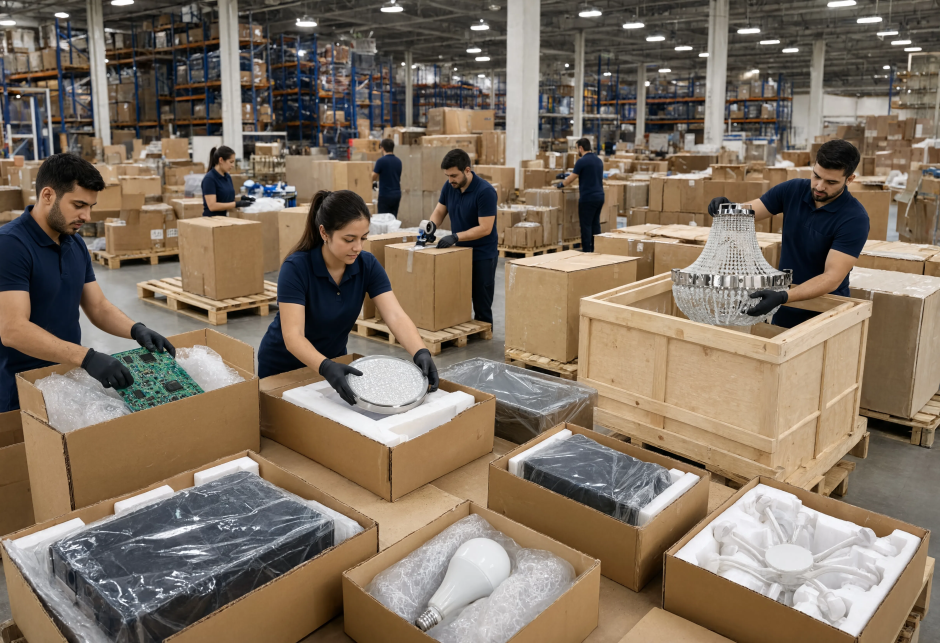
In the modern technological era, electronics and lighting equipment are among the most demanded, yet highly delicate and sensitive commodities in international trade. Smartphones, high-precision circuit boards, LED panels, crystal chandeliers, and industrial lighting systems all share one common vulnerability: any careless shock or moisture fluctuation during transit can lead to irreversible financial losses.
Safe packaging and choosing the right logistical format are the cornerstones of successful international freight forwarding. In this guide, we will discuss how to properly protect high-value electronics, the specific characteristics of FCL and LCL shipping, and how the transport chain operates from major European and Chinese ports to Armenia using the strategic Georgian Port of Poti.
1. The Golden Rules of Packaging Electronics and Lighting Equipment
When transporting sensitive equipment, standard cardboard boxes and tape are simply not enough. Packaging must be multi-layered and specifically designed for transit stress.
-
Electrostatic Discharge (ESD) Protection: Electronic components, motherboards, and microchips are extremely sensitive to static electricity. They must be pre-packed in specialized antistatic bags.
-
Internal Cushioning: Empty spaces inside the box should be filled with molded foam inserts, bubble wrap, or specialized air pillows that absorb road vibrations and shocks.
-
Moisture Control: During maritime transport, humidity levels inside containers can change drastically. The use of silica gel packets is mandatory to prevent internal condensation and moisture damage.
-
External Rigid Shell (Wooden Crating): For large lighting fixtures, delicate chandeliers, or items containing crystal elements, wooden crating is highly recommended. This prevents external pressure from physically damaging the contents of the box.
2. Logistical Formats: Full Container Load (FCL) vs. Less than Container Load (LCL)
Beyond packaging, the most critical decision involves selecting the right type of container load space.
-
Full Container Load (FCL): If you are shipping a large quantity of electronics (such as a batch of household appliances, solar panels, or heavy industrial lighting equipment), leasing an entire container is the best solution. In this case, the container is loaded and sealed directly at the manufacturer’s warehouse, reducing the risk of damage during mid-transit handling and cross-docking.
-
Less than Container Load (LCL / Groupage): For small and medium businesses importing a limited number of lighting fixtures or electronic accessories, renting a full container is financially unfeasible. This is where groupage comes into play. Your packed goods are delivered to a logistics hub, where they are consolidated (combined) with cargo from other shippers into one shared container. You pay strictly for the volume (CBM) your cargo occupies. In LCL shipping, high-quality external packaging becomes doubly critical since diverse types of goods might be stowed nearby.
3. Geographical Hubs: European and Chinese Ports
The world’s primary manufacturers of high-end electronics and premium lighting systems are concentrated in Europe and China.
-
The European Route: Germany, the Netherlands, Italy, and Austria are renowned for their premium lighting architecture, medical equipment, and industrial electronics. Consolidated shipments from these countries gather at major European ports like Rotterdam (Netherlands), Antwerp (Belgium), Hamburg (Germany), and Genoa (Italy). Container ships depart regularly from these hubs, ensuring steady FCL and LCL cargo flows.
-
China’s Manufacturing Might: China is the global epicenter for electronics assembly and LED lighting manufacturing (especially the Shenzhen and Guangdong regions). Freight is dispatched through world-famous ports: Shanghai, Ningbo, Qingdao, as well as Shenzhen and Guangzhou. The latter two serve as the main collection gates for electronics, boasting hundreds of specialized consolidation warehouses optimized for professional groupage.
4. Transit to Armenia via the Port of Poti
For containers arriving by sea from either Europe or China, the primary transit gateway to Armenia is the Georgian Port of Poti.
After traversing the Suez Canal and the Mediterranean Sea, cargo vessels enter the Black Sea and berth at the Poti terminals. At this juncture, the logistical process splits into two distinct operational flows:
-
For Full Containers (FCL): The container is discharged from the vessel directly onto a dedicated container chassis. Without being opened, it proceeds under transit documentation straight to the Armenian border (Bagratashen or Gogavan) and onwards to customs terminals in Yerevan.
-
For Consolidated Cargo (LCL): The container can be destuffed and sorted directly at the Port of Poti’s CFS (Container Freight Station), where goods are cross-docked into enclosed trucks bound for Yerevan. Alternatively, the container travels sealed to a consolidation warehouse in Yerevan, where final segregation and distribution to individual consignees take place.
The overland distance from Poti to Yerevan is roughly 450–500 km. This means that following customs clearance and loading at the port, your delicate electronics will reach Armenia within just 24 to 48 hours.
International logistics for electronics and lighting products leaves no room for error. Implementing appropriate antistatic and shockproof packaging, correctly evaluating FCL versus LCL space, and maintaining a well-coordinated link between the ports of China, Europe, and Poti guarantees that your high-value cargo arrives in perfect working condition. Always trust your supply chain to experienced operators who thoroughly understand the nuances of handling sensitive freight.
