
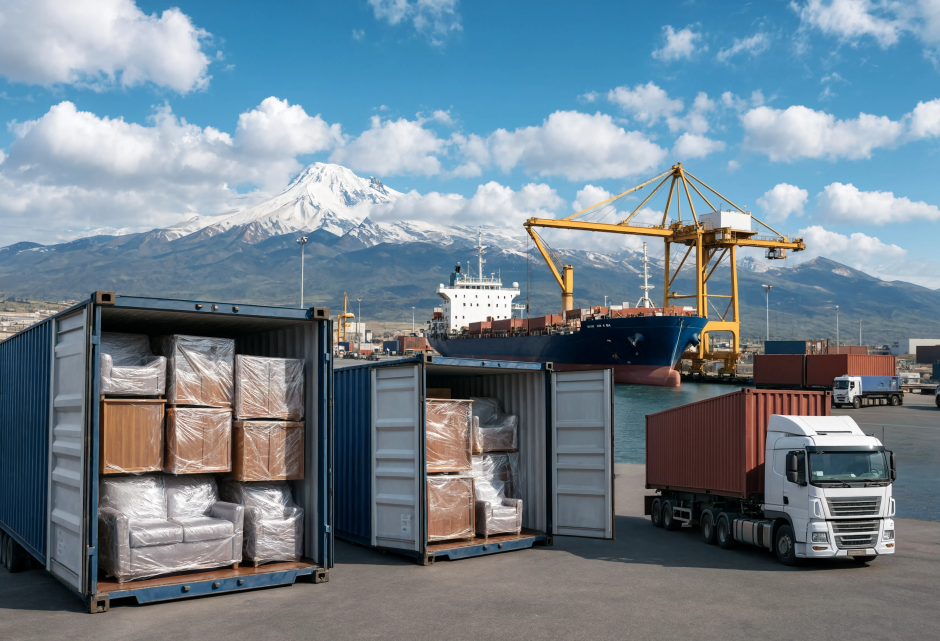
In the era of international trade and dynamically developing markets, importing bulky furniture has become an essential part of the daily operations for individuals, large businesses, and design studios alike. Whether it is exquisite Italian living room furniture or modern office furnishings from China, the main challenge is always the same: how to organize container shipping to Armenia safely, quickly, and, most importantly, cost-effectively?
In the logistics world, the answer to this question comes down to two main acronyms: FCL (Full Container Load) and LCL (Less than Container Load – Consolidated/Groupage cargo).
In this blog, we will analyze the nuances of large furniture logistics in detail, compare FCL and LCL options, walk through key ports in Europe and China, and understand why the Georgian Port of Poti serves as the main gateway for transporting cargo to Armenia.
1. FCL vs LCL: What is the Difference for Bulky Furniture?
When it comes to furniture, volume and weight are often disproportionate. Furniture occupies a lot of space (cubic meters – CBM) but might not carry maximum weight. It is this exact characteristic that dictates the choice of shipping format.
FCL (Full Container Load)
With the FCL option, you lease the entire container (usually a 20-foot or 40-foot High Cube). The entire space belongs exclusively to your goods.
-
When to choose: When ordering furniture for an entire house or office, or when the total volume of goods exceeds 15-20 CBM.
-
Advantages: The risk of damage during loading and unloading is minimal, as the container is sealed at the supplier’s warehouse and opened only at the final destination. It is also faster, as there is no need for consolidation at intermediate warehouses.
LCL (Less than Container Load / Groupage)
LCL or, as it is frequently called, groupage, is a logistics solution where your cargo “shares” the container space with goods from other shippers. You pay only for the actual volume (CBM) or weight occupied by your cargo.
-
When to choose: When you have purchased just a single sofa, a bedroom set, or a few chairs, whose volume is small and does not justify the cost of an entire container.
-
Advantages: Huge financial savings for small and medium-sized batches of cargo.
2. Logistics Geography: European Countries and Ports
European high-quality furniture traditionally enjoys great demand in Armenia. Italy, Germany, Spain, and Poland are powerful centers of furniture manufacturing. Cargo from these countries is gathered at consolidation warehouses and directed to the largest European ports.
For transporting large furniture, the following ports hold key significance:
-
Rotterdam (Netherlands) and Antwerp (Belgium): The mightiest hubs of Northern Europe, from where major FCL and LCL shipments are dispatched worldwide.
-
Hamburg (Germany): The best point for consolidating German and Scandinavian-made furniture.
-
Genoa and Trieste (Italy): These Mediterranean ports are of strategic importance for the direct and fast transportation of luxury Italian furniture.
-
Valencia (Spain): The main gateway for exporting Spanish furniture and designer accessories.
From Europe, cargo can move either multimodally (by land transport to the port, then by sea) or entirely by large land container trucks passing through the territory of Turkey or Georgia.
3. The Big Leap from the East: China’s Manufacturing Hubs and Ports
China is currently the undisputed global leader in furniture production. Foshan city, located in Guangdong province, is famously known as the “furniture capital of the world.” Most Armenian businesses make their wholesale furniture purchases from here.
Container shipping from China is organized through the following major ports:
-
Shanghai: The busiest port in the world, offering regular and uninterrupted sailings.
-
Shenzhen and Guangzhou: The closest hubs to Foshan. This is a perfect choice for shipping both full (FCL) and consolidated (LCL) furniture cargo, as warehouse logistics here are developed to the highest standard.
-
Ningbo (Ningbo-Zhoushan): Another powerful port providing high throughput capacity and competitive rates.
-
Qingdao: The main point of Northern China, used for goods manufactured in that region.
4. The Transit Route: Port of Poti as the Main Gateway to Armenia
Since Armenia is a landlocked country, it relies heavily on Georgian infrastructure to organize maritime container shipping. The Port of Poti plays a central role in this chain.
Container ships coming both from China (via the Suez Canal and the Mediterranean Sea) and from Europe reach the Black Sea and unload in Poti.
How the Scheme Works:
-
Maritime Stage: The container (FCL or LCL) arrives by ship in Poti.
-
In case of Consolidated Cargo (LCL): Cargo can either be opened (de-consolidated) directly at special port terminals and reloaded into trucks heading to Yerevan, or the container is transported sealed to customs warehouses in Yerevan, where final sorting takes place.
-
In case of Full Load (FCL): The container is loaded from the ship onto a dedicated container truck (or rail platform) and heads directly to Armenia’s customs checkpoints (such as Noragavit or Araratyan customs).
The overland distance from Poti to Yerevan is only about 450-500 km, allowing goods to reach Armenia within 1-2 days after unloading.
5. Risks in Large Furniture Shipping and How to Avoid Them
Furniture is a delicate commodity. Glass elements, soft fabrics, and lacquered wooden surfaces can easily be damaged by moisture, shocks, or improper stacking.
-
Professional Packaging: This is the most crucial stage. Demand that the supplier use five-layer cardboard, corner protectors, bubble wrap, and, if necessary, wooden crates.
-
Accurate Volume Calculation: For LCL shipping, payment is calculated by volume. If the furniture can be transported disassembled (Flat-pack), never ship it assembled. This will reduce the volume two to three times, saving your money.
-
Cargo Insurance: Considering the long journey (especially the 35-45 days from China to Poti), Cargo Insurance is a mandatory requirement for peace of mind.
What to Choose?
If your cargo volume is small (from 1 to 10-12 CBM), definitely choose the LCL (consolidated cargo) option. This will prevent you from overpaying for empty space. However, if you are furnishing an entire hotel, restaurant, or a large mansion, FCL (full container) will provide maximum security and speed.
A correctly chosen logistics partner with reliable agent control in the ports of Europe and China, as well as experience at the Poti terminals, will ensure that your bulky furniture arrives intact and within the set deadlines.
