
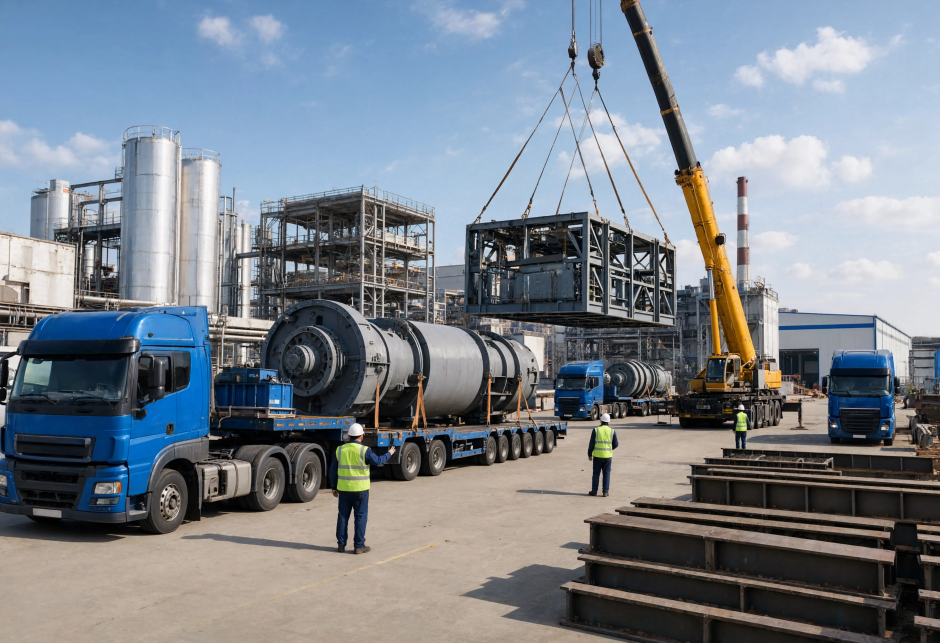
Smooth and uninterrupted logistics is one of the cornerstones of a successful manufacturing business. Transporting machinery, raw materials, heavy equipment, and entire production lines requires a specialized approach, precise engineering calculations, and the selection of optimal transit routes. When building supply chains to Armenia, logistics managers must carefully consider geographical challenges and combine different modes of transport.
In this article, we will explore how to properly organize the transportation of heavy and oversized cargo from global markets and what factors to consider to optimize your supply chain costs.
1. FCL vs. LCL: Full Load or Groupage Cargo?
The first step in importing manufacturing equipment or raw materials is choosing the right freight format:
-
Full Cargo (FCL/FTL): If you are moving large production lines or heavy machinery that occupies an entire container or truck, Full Container Load (FCL) or Full Truckload (FTL) is the way to go. This ensures maximum speed, safety, and direct delivery without intermediate handling.
-
Consolidated/Groupage Cargo (LCL/LTL): For small to medium enterprises (SMEs), importing small batches of raw materials or spare parts for machinery is common. In this case, the groupage system allows multiple companies to share space within a single container. You only pay for the volume or weight your cargo occupies, significantly lowering transportation costs.
2. The European Vector: From Germany to Rotterdam
High-quality European machinery and components are always in high demand among Armenian manufacturers. Shipping heavy cargo from European countries such as Germany, Italy, France, and Poland is usually carried out via multimodal transport networks.
Major European maritime hubs, including the ports of Rotterdam (Netherlands), Hamburg (Germany), and Antwerp (Belgium), serve as primary consolidation and departure points. From these hubs, oversized cargo is securely loaded into sea containers or onto specialized vessels heading toward the Black Sea.
3. The Asian Vector: China’s Mega Ports
Today, China is a powerhouse for manufacturing equipment, electronics, and industrial raw materials. Managing heavy cargo logistics from China requires seamless coordination with the country’s largest coastal gateways.
Key shipping hubs such as the ports of Shanghai, Ningbo, Shenzhen, and Qingdao offer regular container liner services. Freight from China travels across major ocean routes to reach the Black Sea basin, serving as a cost-effective solution for heavy industrial cargo.
4. Transit to Armenia via the Port of Poti
Since Armenia is a landlocked country, transit corridors play a vital role in its international trade. The main gateway for sea freight arriving from both Europe and China to Armenia is the Port of Poti in Georgia (alongside the Port of Batumi).
Upon arrival at the Port of Poti, containers undergo discharging and customs transit documentation. Subsequently, heavy cargo is loaded onto specialized trucks (low-boys/trailers) or standard trucks and transported by road through the Bagratashen, Bavra, or Gogavan border crossing points directly into Armenia.
5. Practical Steps for Manufacturers
To ensure a seamless heavy freight operation, consider the following best practices:
-
Accurate Technical Specifications: Provide your freight forwarder with precise dimensions, gross weight, and center-of-gravity drawings.
-
Flawless Documentation: Ensure that the packing lists, commercial invoices, and certificates of origin are meticulously prepared. This is crucial for groupage (consolidated) shipments to prevent border delays.
-
Cargo Insurance: Never skimp on insurance when moving high-value industrial machinery.
Choosing an experienced logistics partner and utilizing the optimized route via the Port of Poti ensures that your manufacturing facility receives its equipment safely, on time, and within budget.
