
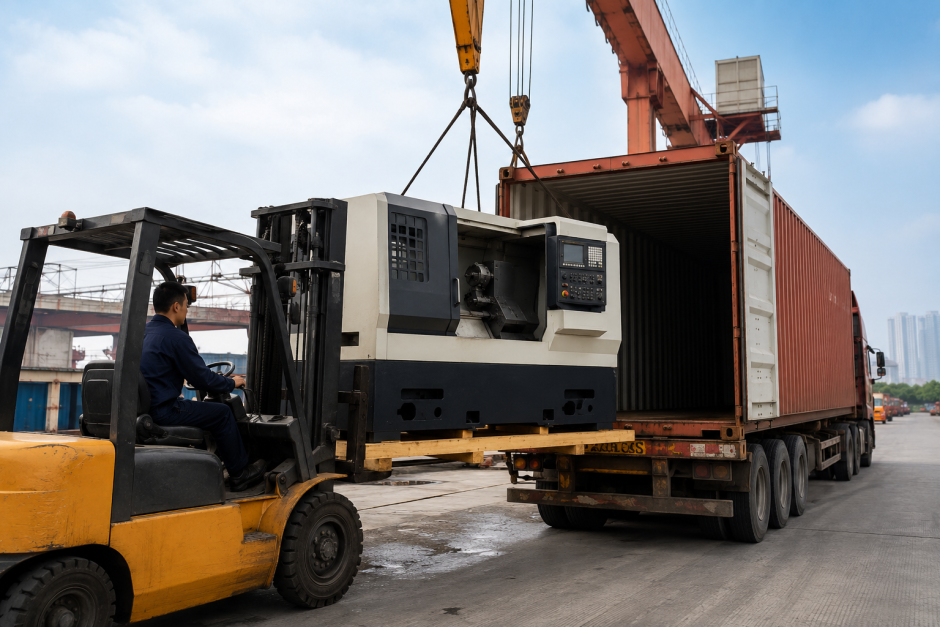
China has long ceased to be just a manufacturer of simple consumer goods. Today, it stands as one of the primary hubs of global industry, from which the entire world—including leading European countries like Germany, Italy, and France—imports high-tech machinery, production lines, and heavy industrial equipment.
In tandem with the growth of Armenia’s economy and local manufacturing, purchasing Chinese machinery has become a priority for Armenian entrepreneurs. However, unlike apparel or electronics, importing industrial equipment requires a specialized approach, precise logistical calculations, and a deep understanding of legal nuances.
In this guide, we will break down the entire process of importing heavy machinery from China, from selecting a factory to organizing freight forwarding to Armenia via the Port of Poti.
1. The Starting Point: Supplier Selection and Technical Specifications
When buying industrial machinery, the biggest mistake is looking solely at the price. In the Chinese market, a machine with the exact same external appearance can cost either $5,000$ or $25,000$. The difference lies in the quality of internal components, motor power, and the thickness of the metal used.
-
The Importance of European Standards: Major Chinese manufacturers often produce two types of equipment: one for the domestic (Asian) market and one for the export (European/American) market. Give preference to factories that hold a CE certificate and export their products to Europe (such as Germany, Poland, or the Netherlands). This serves as a guarantee that the machinery will be safe and durable.
2. Shipping Configurations: Full Container Load (FCL) vs. Consolidated Cargo (LCL)
Once the machinery is ready, the next critical step is choosing the right logistics model. Depending on the dimensions and weight of your equipment, there are two main options:
Full Container Load (FCL)
If you have ordered a large production line, stone-cutting machines, or several large industrial units that occupy an entire container (20ft or 40ft), FCL is your best choice. In this case, the container is sealed directly at the factory and opened only at the customs terminal in Yerevan, significantly reducing the risk of damage.
Less than Container Load (LCL) & Groupage
For small and medium-sized enterprises (SMEs), it is often only necessary to import one or two small machines (e.g., a laser engraver or a CNC milling machine) that occupy only a fraction of a container. In this scenario, the groupage system is utilized.
-
Your cargo is transported to a dedicated consolidation warehouse in China.
-
There, smaller shipments from various buyers are gathered and packed together into a single shared container.
-
You only pay for the volume (Cubic Meters – CBM) or weight that your cargo occupies, allowing you to drastically cut down on logistics costs.
3. The Maritime Route: Main Chinese Ports
China possesses the most advanced port infrastructure in the world. Depending on the province where your manufacturing factory is located, loading can be handled from the following major ports:
-
Shanghai: The world’s busiest port, handling a massive share of industrial machinery exports.
-
Ningbo (Ningbo-Zhoushan): Located near Shanghai, it is highly reputable for handling heavy industrial cargo.
-
Shenzhen / Guangzhou: Southern Chinese hubs that are ideal for electronics and light industrial equipment.
-
Qingdao / Tianjin: Northern ports from which heavy machinery and metallurgical equipment are predominantly exported.
4. Transit to Armenia: The Crucial Role of Poti Port
Since Armenia is landlocked, the most optimal and widely used route for ocean containers arriving from China is transit through the Georgian ports of Poti or Batumi.
[Chinese Port] ──(Ocean Freight)──> [Suez Canal] ──> [Med/Black Sea] ──> [Port of Poti] ──(Land Freight)──> [Armenia / Yerevan]
How the Transit via Poti Works:
-
Maritime Phase: The container vessel crosses the Indian Ocean, enters the Mediterranean Sea via the Suez Canal, and passes through the Bosphorus Strait to reach the Black Sea at the Port of Poti. This phase typically takes 35 to 45 days.
-
Poti Terminal Handling: At the port, the container is discharged from the vessel. If the shipment is FCL, it is loaded directly onto an Armenian or Georgian truck (container chassis). If it is a consolidated shipment (LCL), it may be destuffed at a Poti warehouse and transferred to Yerevan alongside other partial cargoes.
-
Inland Phase: From Poti, the truck drives toward the Georgian-Armenian border (Bagratashen or Bavra) and arrives in Yerevan (usually within 2 to 3 days).
5. Essential Legal and Customs Nuances
Importing machinery requires absolute documentary precision. A single improperly formatted document can lead to prolonged cargo delays in Poti or at the Armenian customs house, resulting in heavy demurrage fees and financial losses.
Required Documents Checklist:
-
Commercial Invoice and Packing List.
-
Bill of Lading (B/L): The primary contract and receipt for maritime carriage.
-
Certificate of Origin: Standard proof that the goods were manufactured in China.
-
Technical Passport and Description: Vital for correctly identifying the HS Code and calculating the customs value.
💡 Pro Tip: Many industrial machines imported into Armenia can be exempted from customs duties or VAT if they are included in government-backed investment incentive programs or lack local alternatives (under Eurasian Economic Union – EAEU regulations). Consult a customs broker before the cargo departs China.
Importing machinery from China is a powerful catalyst for scaling your business operations. To ensure a seamless process, select a supplier meeting European standards, properly evaluate FCL vs. LCL (groupage) options, partner with an experienced freight forwarder with established lanes from Shanghai or Ningbo to Poti, and prepare all customs documentation well in advance. Proper planning will deliver the “new heart” of your factory to Armenia safely and on schedule.
