
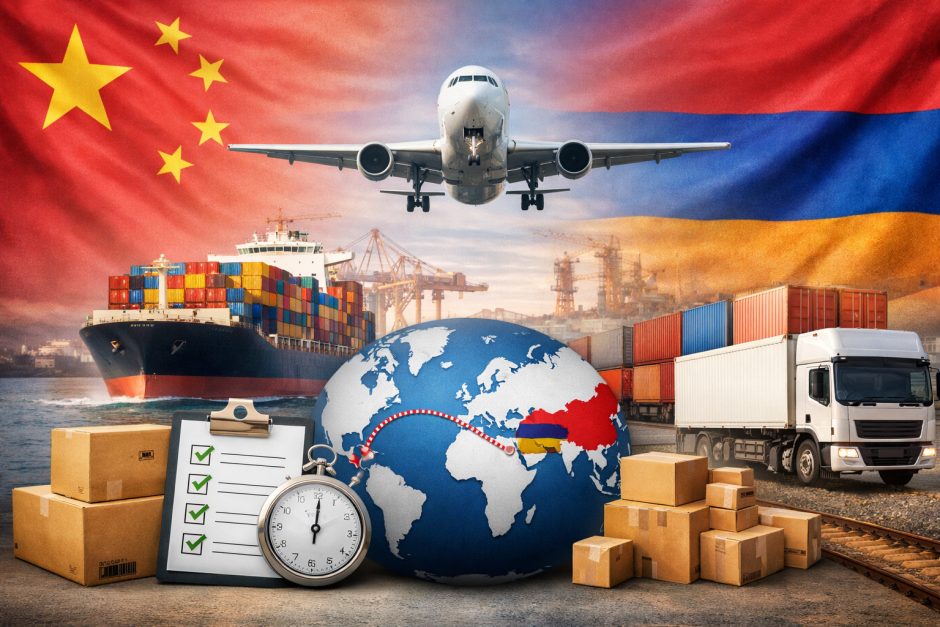
Today, as international markets become increasingly integrated and competitive, China–Armenia B2B transportation has become a key factor in business development. Importing companies often face logistical and customs-related challenges, as well as issues related to cost control and efficient time management. Well-organized B2B transportation not only ensures the safe and timely delivery of goods but also helps reduce risks and enhance business competitiveness.
Why China–Armenia B2B Transportation Is Important
China is one of the world’s major manufacturing hubs and a primary supplier for Armenia across various sectors, including electronics, raw materials, apparel, and plastics.
B2B transportation enables companies to:
-
Minimize the risk of product shortages
-
Reduce price fluctuations and increase predictability
-
Achieve more efficient supply chain management
For this reason, businesses must choose reliable partners who can ensure efficient China–Armenia freight transportation.
Choosing the Right Logistics Company
Selecting a logistics partner is a critical step in organizing B2B transportation. A reliable company should offer the following services:
-
International freight transportation via air, sea, and land routes
-
Packaging and warehousing to ensure cargo safety and quality
-
Customs clearance support with fast and accurate documentation
-
Cargo insurance to provide financial protection in case of damage or loss
It is essential for businesses to cooperate with companies that provide logistics solutions for business, as this reduces internal resource costs and improves operational efficiency.
Payment and Cost Control
Cost management plays a crucial role in China–Armenia transportation.
-
Work directly with primary suppliers to minimize intermediary involvement
-
Calculate all expenses in advance, including transportation, customs duties, insurance, and warehousing services
-
Choose transportation planning methods that minimize waiting times
These steps enable efficient freight transportation, improve business predictability, and reduce unexpected costs.
Risk Management
High-level B2B transportation includes thorough risk assessment and mitigation. Potential risks include:
-
Direct loss or damage to cargo
-
Currency fluctuations during transportation
-
Delays or issues with customs documentation
To reduce these risks, it is recommended to:
-
Use insurance and maintain consistent tracking of all shipments
-
Choose an experienced logistics partner
-
Maintain well-structured documentation in both physical and digital formats
Types of Transportation
China–Armenia shipments can be carried out using different modes of transport, depending on speed, cost, and cargo type.
-
Air freight – fast and suitable for lightweight or high-value goods
-
Sea freight – economical and ideal for large-volume shipments
-
Land and rail transportation – suitable for combined and multimodal solutions
The choice of transport method should be based on specific business requirements, including timeframes, cost, and security level.
Advanced Technologies in B2B Logistics
Modern international logistics relies heavily on digital technologies to make freight transportation more transparent and manageable.
-
Software solutions track cargo location and status
-
Online reports support business management and decision-making
-
Warehousing and customs processes are increasingly automated
This approach increases efficiency and reduces the likelihood of errors.
Innovation and Eco-Friendly Solutions
Rapidly developing B2B transportation increasingly incorporates green and environmentally friendly solutions to reduce carbon emissions.
-
Use of hybrid or electric vehicles
-
Application of recyclable packaging materials
-
Expansion of multimodal supply chains to reduce costs and environmental impact
These practices enhance a company’s image and support responsible trade.
Business efficiency also depends on detailed reporting and analysis of B2B transportation.
-
Reports should include delivery times, costs, and transportation efficiency
-
Feedback from partners and clients helps improve operational processes
-
Continuous adjustments based on results ensure sustainable growth
China–Armenia B2B transportation goes far beyond simple cargo delivery. It involves strategic planning, risk management, financial control, and the implementation of innovative technologies.
Close cooperation with reliable logistics partners ensures maximum efficiency with minimal risk. By choosing the right solutions and optimal routes, businesses can improve their supply chains, save time and costs, and expand into new markets.
To a large extent, B2B transportation depends on effective planning and time management. Businesses must anticipate all necessary steps in advance, including customs documentation, transport selection, and insurance, to minimize unexpected issues. Combined approaches—such as integrating air and land transportation—help reduce delivery times and costs. The use of innovative technologies, such as real-time cargo tracking systems, enables continuous monitoring and enhances security. These methods provide businesses with reliability and predictability throughout the entire China–Armenia freight transportation process.
