
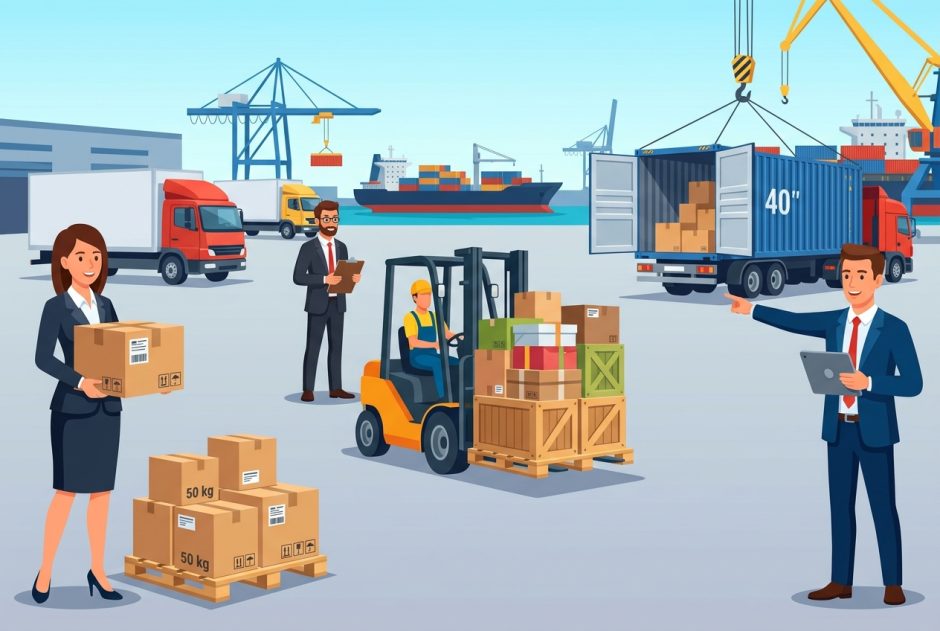
Not every business needs a full container to organize an international shipment.
One company may import 50–100 kg of goods, another may regularly move several tons, while a larger importer may need an entire container for each shipment.
That is why an effective B2B logistics strategy should not be based on one standard solution. The transportation method should be selected according to the cargo volume, weight, product type, shipping frequency, delivery requirements and overall business needs.
For businesses working with international suppliers, flexibility is essential.
The basic principle can be summarized as:
50+ kg → LCL → FCL
This approach allows a business to start with relatively small B2B shipments and move toward larger consolidated shipments or full-container transportation as its import volumes grow.
50+ kg: When Your Business Needs to Move a Smaller Shipment
International trade does not always begin with a container.
A company may want to test a new product, replenish inventory, purchase raw materials, introduce a new supplier or import a seasonal product.
These shipments can be commercially important even when they are not large enough to fill a container.
In such cases, booking a full container may not be the most efficient solution.
For B2B shipments starting from approximately 50 kg, LCL (Less than Container Load) transportation can provide a flexible alternative.
With LCL, cargo from different businesses can be consolidated as part of the same transportation process.
This means that a company does not necessarily have to pay for an entire container when its own cargo occupies only part of the available capacity.
Who can benefit from LCL shipping?
LCL can be particularly useful for businesses that:
- are starting to import internationally;
- work with small or medium-sized shipment volumes;
- want to test a new product;
- do not want to hold excessive inventory;
- receive regular but relatively small shipments;
- need flexibility in their supply chain.
For example, an Armenian importer may purchase a certain quantity of construction materials, electrical products, furniture components or other commercial goods from China.
If the shipment does not justify a full container, LCL can allow the business to move the cargo without waiting until enough goods are accumulated to fill an entire container.
LCL: A Flexible Solution for Small and Medium B2B Shipments
One of the main advantages of LCL is flexibility.
A business does not necessarily need to wait until its cargo reaches full-container volume before arranging international transportation.
This can be particularly important when inventory availability affects sales, production or customer deliveries.
For example, consider a company that imports commercial products from several suppliers in China.
If each order is relatively small, LCL transportation can allow those shipments to enter the logistics process without requiring a full container for every individual order.
The logistics model adapts to the business instead of forcing the business to adapt its purchasing volume to the container.
When Does It Make Sense to Move from LCL to FCL?
As a business grows, its logistics requirements usually change as well.
A company may initially import 100, 200 or 500 kg at a time. As demand increases, shipment volumes can grow to several tons or eventually reach full-container capacity.
At this stage, FCL (Full Container Load) can become a more appropriate solution.
FCL is designed for full-container shipments, where the container is dedicated to one shipment.
For larger B2B importers, this can provide a more structured and scalable transportation model.
Advantages of FCL for Larger Shipments
Full-container transportation can be particularly suitable when:
- cargo volume is high;
- the business imports large quantities;
- shipments are regular and predictable;
- supply chain planning is important;
- the company needs a dedicated container solution.
Depending on the cargo and its dimensions, different container types and transportation solutions may be considered.
The key is to match the container and transportation method to the actual characteristics of the shipment.
50+ kg → LCL → FCL: A Logistics Model That Can Grow with Your Business
The most important advantage of this model is scalability.
The logistics strategy can develop together with the business:
Small shipment → LCL → larger volume → FCL
This is not a mandatory progression for every company, but it can be a natural development path for many importers.
A new importer may start with 50–200 kg shipments.
As product demand increases, the company may move larger LCL shipments.
When shipment volumes reach a level where a full container becomes more commercially efficient, the business can move to FCL transportation.
This allows the company to avoid paying for unnecessary capacity before it actually needs it.
Shipping from China to Armenia: Solutions for Different Cargo Volumes
For Armenian businesses importing from China, an effective consolidation and international transportation system can be especially important.
A company may purchase goods from several suppliers located in different Chinese cities.
For example, one supplier may be located in Guangzhou, another in Qingdao and another in Shanghai.
In this situation, logistics is not simply about moving cargo from one location to another.
The process may involve coordinating suppliers, cargo collection, consolidation, warehousing, international transportation and delivery to Armenia.
This becomes particularly important for businesses that regularly work with multiple suppliers.
A well-organized logistics process can help turn several separate supplier orders into one coordinated international shipment.
Shipping from Europe to Armenia
The same principle applies to B2B freight from Europe to Armenia.
Businesses importing from European suppliers can have very different shipment volumes depending on their industry, products and purchasing frequency.
Smaller shipments may be handled through consolidated transportation, while larger volumes may justify dedicated truck, container or other full-load solutions.
This flexibility can be especially valuable for companies with a broad product range where each order may have a different volume.
How Should a Business Choose Between LCL and FCL?
Cargo weight alone should not determine the transportation method.
Several factors should be considered.
1. Cargo volume and weight
The larger the shipment, the more important it becomes to compare the total cost of LCL with the cost of a full-container solution.
2. Product characteristics
Fragile, oversized, heavy or special cargo may require a specific transportation and handling approach.
3. Shipping frequency
A company importing small quantities every month may benefit from the flexibility of LCL. Businesses with predictable, high-volume imports may find FCL more suitable.
4. Delivery requirements
For many businesses, delivery time is just as important as transportation cost. Delays can affect production, inventory and sales.
5. Total logistics cost
Businesses should consider the complete logistics process rather than only the headline transportation price.
Consolidation, warehousing, cargo handling, documentation and other operational factors can all affect the final cost.
Why B2B Businesses Need a Specialized Logistics Partner
For large importers, freight transportation is not simply a delivery service. It is part of the company’s supply chain.
A logistics partner should understand more than the weight and dimensions of the cargo.
The objective should be to identify a transportation solution that matches the company’s actual commercial requirements while helping maintain control over cost, timing and the overall supply chain.
Clever Logistics & Transport provides B2B international freight transportation solutions for both consolidated shipments starting from 50+ kg and larger, full-load cargo.
We organize LCL and FCL transportation from China, Europe and other destinations to Armenia, depending on cargo type, volume and business requirements.
The goal is simple: not to force every business into the same logistics model, but to select the solution that fits the shipment.
Your Shipment Does Not Fill a Container? That Is Not a Problem.
International freight transportation does not have to start with a full container.
If your business imports 50+ kg of commercial cargo, LCL transportation can provide a practical solution.
As your business grows and shipment volumes increase, you can move toward larger consolidated shipments and eventually FCL transportation.
50+ kg → LCL → FCL
This model allows logistics to adapt to your actual business volume—from smaller commercial shipments to large-scale international supply chains.
Whether you import from China, Europe or another market, the right logistics solution starts with understanding your cargo.
Share your cargo weight, volume, origin and product type to determine the most suitable transportation option for your business.
