
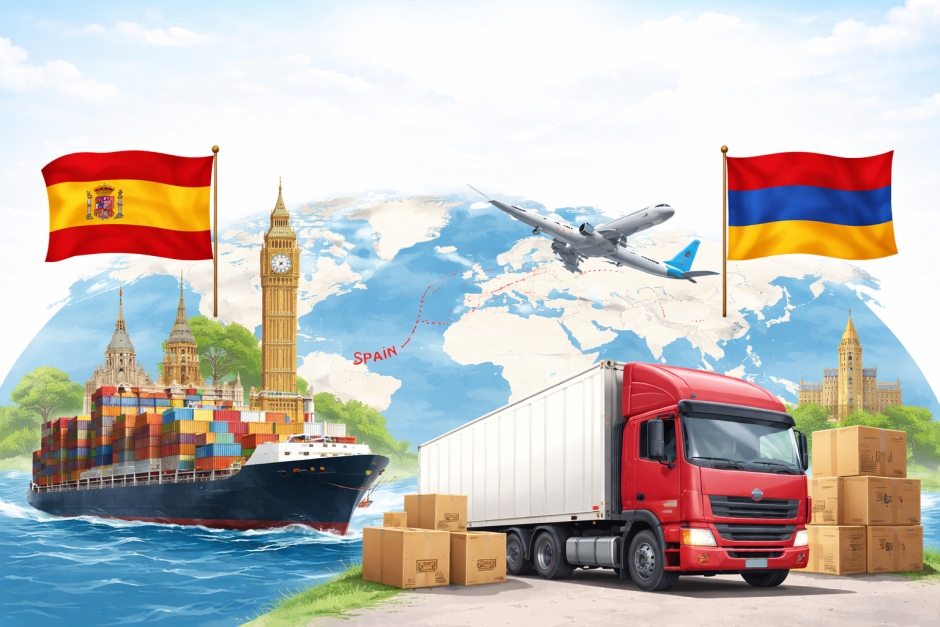
Spain–Armenia freight is a highly demanded service, especially for companies involved in importing or exporting goods within large-scale B2B collaborations. Whether you are a small or medium-sized business, having the right logistics partner can be crucial for timely delivery, cost efficiency, and proper customs handling. In this article, we will explore the most effective routes for shipping from Spain to Armenia, discuss opportunities with European partners, and explain the benefits of B2B logistics services.
Why Choose Spain as a Business Partner
Spain is one of Europe’s leading economic hubs, with active industrial, commercial, and agricultural sectors. For businesses, it is important to understand that shipping from Spain to Armenia often involves goods such as food products, technological equipment, clothing, footwear, and other items that require high-quality storage and transport solutions.
Collaboration with European freight partners in countries including the UK, Germany, France, and Italy allows businesses to select the most tailored routes and services based on volume, pricing, and delivery timeframes.
Features of B2B Logistics Services
Spain–Armenia freight requires B2B logistics services, which provide the following advantages:
- Personalized services – businesses receive initial consultation to select the best route and service level (express, economy, customs support).
- Volume flexibility – for large shipments, containerized transport or bulk deliveries are possible.
- Customs support – the company handles all documentation, saving time and reducing financial risks.
- Reliable European partners – companies in Spain and other European countries follow standardized procedures, minimizing delays.
Shipping Routes
Shipping from Spain to Armenia can be carried out via three main methods: sea and air transport, and land transport.
1. Sea Transport
Sea transport is ideal for large containers that need to reach Armenia cost-effectively and safely. Routes typically pass through Spain → European ports (France, Germany, Italy) → Black Sea ports → Armenia.
Advantages:
- Low cost for high-volume shipments
- Door-to-door delivery possible
- High safety and standardized processes
Limitations:
- Longer delivery time – 20–40 days
- Weather-dependent risks
2. Air Transport
Air transport is the best option when speed is critical. Goods usually arrive in Yerevan via direct flights or through major European cities (Madrid, Barcelona, London, Paris).
Advantages:
- Fast delivery – 2–7 days
- Suitable for high-value goods
- Accelerated customs processing
Limitations:
- Higher cost
- Dependent on flight schedules
3. Land Transport
Land transport is a combined option, using trucks or rail, mainly for consolidated shipments within Europe. Example route: Spain → France → Germany → Armenia.
Advantages:
- Moderate cost
- Average delivery time – 10–20 days
- Suitable for containers and smaller shipments
Limitations:
- Requires contract-based transport security monitoring
- Possible customs delays
B2B Collaboration and the Role of Logistics Partners
Organizing Spain–Armenia freight without a logistics partner can lead to delays, documentation errors, and increased costs. A specialized logistics company ensures:
- Flexible and tailored pricing plans
- Customs documentation support
- Cargo insurance
- Full shipment visibility through tracking systems
Working with European partners simplifies the collection of goods from Spain, the UK, France, Germany, and Italy, reducing delivery times and costs.
Key Considerations for Freight
- Type of cargo – food, electronics, clothing, etc. Some goods require special conditions (temperature control, humidity).
- Import and export regulations – each country’s customs rules vary; a good logistics partner provides guidance.
- Speed vs. cost – choose a route balancing delivery speed and expenses.
- Packaging – proper packaging is essential, especially for high-value goods.
Spain–Armenia freight for B2B businesses may seem complex, but with the right logistics partner, the process becomes smooth, secure, and efficient. Choose partners experienced in European markets who can manage sea and air transport as well as land shipments, fully meeting B2B requirements.
This guide will help you plan shipments, reduce costs, and accelerate delivery times.
