
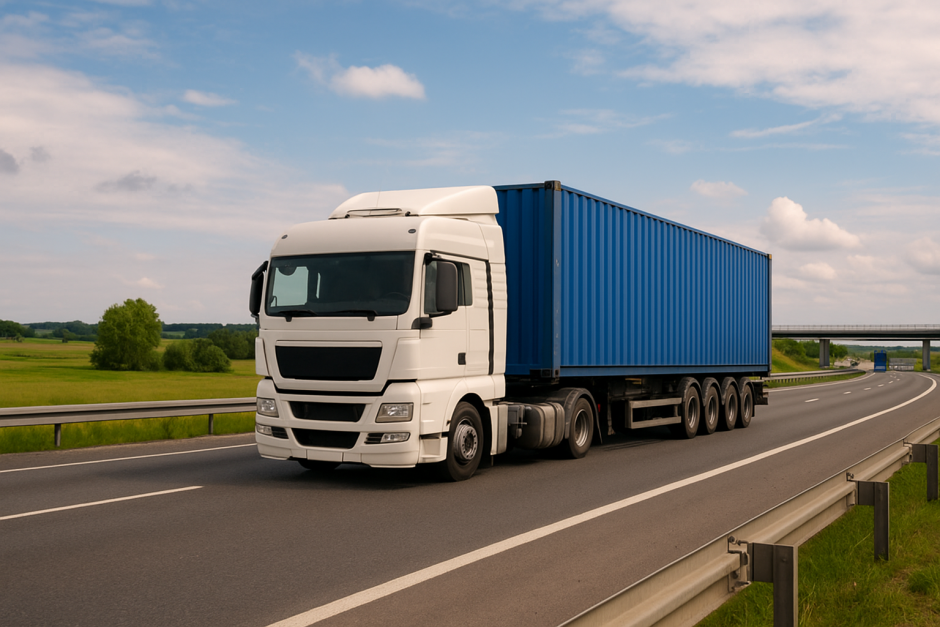
Here are several key European countries and their main freight transport models.
Germany
Germany is one of Europe’s largest logistics and manufacturing hubs. Road freight routes heading east and south play a key role in European transport. Most road shipments in the region pass through Germany. In terms of rail freight, there are about 10 major railway corridors connecting Germany with other countries. Its well-developed supply chain infrastructure makes Germany a strategic gateway to Poland, the Czech Republic, Austria, and beyond.
Netherlands
The Netherlands, especially Rotterdam and Antwerp (in Belgium), are Europe’s main ports, making the Netherlands a crucial freight hub. Road shipments from the Netherlands to Germany have grown by over 48%. The country is widely used for both inbound and outbound shipments, including groupage freight (LCL), where multiple suppliers’ goods are consolidated into a single shipment.
Belgium
Belgium is another active player in road transport, especially for routes between Belgium and Germany, which have seen a 69% increase. Its infrastructure, ports, and logistics network make Belgium ideal for both full-load (FCL) and groupage (LCL) freight transport.
Italy
Italy serves as a strategic center for southern routes connecting Northern and Southern Europe. Its logistics network supports both export and import routes, especially from Italy to Eastern Europe and other markets. Italy’s north-south trade corridors are crucial for the flow of goods within Europe.
Poland
Poland plays an increasingly important role in international road freight, with rapid growth in cross-border logistics. Its economic development and expanding logistics infrastructure make Poland a key hub for European cargo movement.
Austria
Austria serves as a central transit point in southeastern Europe, connecting the Baltic and Adriatic corridors. The Baltic–Adriatic Corridor passes through Austria, enabling the integration of road, rail, and waterway transport — a strong example of intermodal logistics solutions.
These countries demonstrate how diverse European transport routes can be — combining road, rail, and sea freight for efficiency and flexibility.
Full and Groupage Freight Transport
The efficiency of a supply chain largely depends on whether goods are shipped as Full Loads (FCL) or Groupage Loads (LCL).
-
Full Load (FCL/FULL TRUCK LOAD): The entire container or truck is used by one supplier. This is ideal when the shipment volume justifies full use of transport capacity.
-
Groupage Load (LCL/LESS THAN CONTAINER LOAD): Multiple suppliers’ goods are combined in one shipment, reducing costs through consolidation.
In Europe, both models are widely used. For LCL shipments, suppliers must ensure proper packaging, centralized collection points, and clear logistics tracking to guarantee safe and timely delivery.
Packaging and Insurance
Packaging and insurance are critical to prevent damage and loss during transportation.
Packaging should match the type, quantity, and transport mode (road, rail, or sea) of the cargo, ensuring protection from weather, moisture, and impact.
Insurance, though not always legally mandatory, is strongly recommended for international and customs-related shipments to cover loss, damage, or delays.
Before selecting a freight provider, companies should verify that packaging and insurance meet international logistics standards.
Seamless Supply Chain
Ensuring a smooth supply chain involves:
-
Accurate planning: Defining when goods are loaded, when the truck departs, when it crosses borders, and when it arrives at the final destination.
-
Choosing the right logistics partners: Road, rail, or sea carriers should align to ensure a consistent flow.
-
Intermodal transport: Combining road + rail or road + sea for optimal routes. Intermodal transport in the EU is growing rapidly.
-
Visibility and tracking: Real-time updates, insurance coverage, and shipment tracking enhance reliability.
-
Risk management: Delays, price changes, or customs bureaucracy must be mitigated with contingency plans and alternative routes.
Customs Clearance in Exporting Countries
One of the most critical stages in international freight transport is customs clearance — especially in the exporting country.
Efficient customs procedures reduce delays, storage costs, and administrative expenses.
Exporters must comply with national export regulations, submit required documents (export declaration, invoice, packing list, licenses if needed), and consider trade agreements between countries.
Freight forwarders or customs brokers can help ensure documentation is complete and compliant.
Delays often occur when shipments are held at the border due to incomplete paperwork or inspection issues.
Exporters must ensure all markings, product descriptions, values, and origins are accurately recorded to prevent penalties or re-inspections.
The overall efficiency of freight movement depends on all these factors — transport routes, models (FCL vs LCL), packaging, insurance, customs clearance, and supply chain optimization.
For near-shore operations in Europe, road or rail freight are often the most efficient solutions. Rail transport is also more environmentally sustainable.
Intermodal (combined) transport — such as Germany–Italy road + rail routes — continues to grow, offering flexibility for both full and groupage loads.
Organizing freight transport in Europe requires careful focus on:
-
choosing the right routes and modes (road, rail, sea, or combined),
-
selecting between full or groupage models,
-
ensuring proper packaging and insurance, and
-
streamlining customs processes —
to guarantee a reliable, transparent, and uninterrupted supply chain.
