
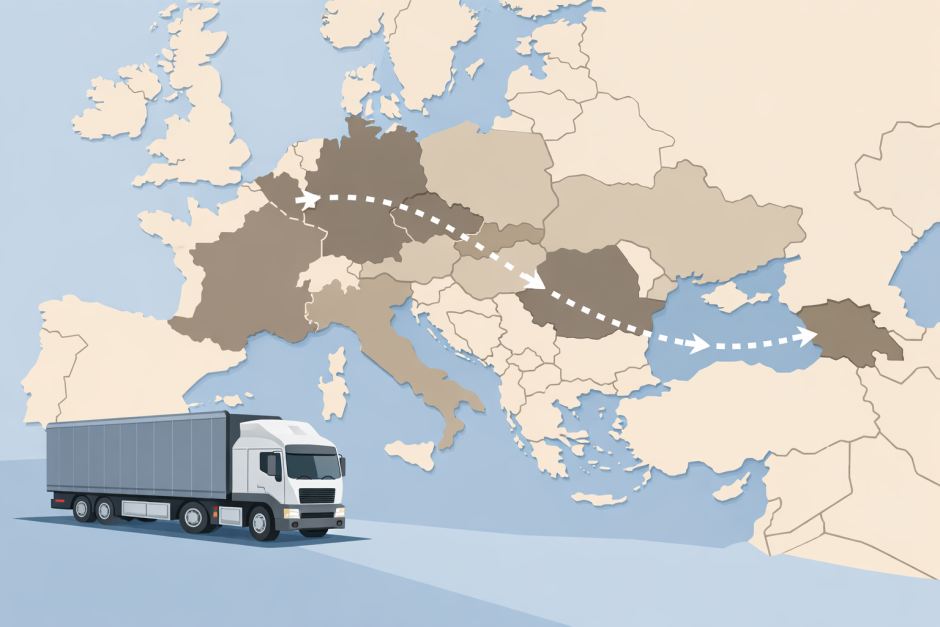
Time in B2B business is often more valuable than the product itself. Especially in the import sector, where market demand is volatile and warehousing costs are high, road freight transportation from Europe to Armenia becomes one of the most efficient logistics solutions.
However, Europe is not a unified market—delivery times can vary significantly depending on the country of origin. In this article, we analyze which European countries offer the fastest road freight transportation to Armenia, why this is the case, and which factors influence delivery speed.
Why road freight from Europe to Armenia is fast
Road freight transportation is considered the “golden middle” between sea and air freight.
Key reasons include:
-
No lengthy port handling and unloading stages
-
More flexible routing options
-
Ideal for regular B2B imports
On average, road freight from Europe to Armenia takes 7–14 days, though shipments from certain countries can arrive even faster.
Germany – one of the most stable and fastest sources
Germany is one of Armenia’s key B2B trade partners.
Why it is fast:
-
Highly developed logistics infrastructure
-
Large number of carriers and consolidation warehouses
-
Fast access to Eastern European transport corridors
Average transit time:
7–10 days
Road freight from Germany to Armenia is especially suitable for industrial equipment, automotive spare parts, and consumer goods.
Poland – Europe’s logistics hub
In recent years, Poland has become a key country in Europe–Armenia logistics routes.
Advantages:
-
Strategic proximity to Eastern Europe
-
Fast customs procedures
-
Wide availability of consolidated (LTL) shipment solutions
Average transit time:
6–9 days
In many cases, shipments from Poland to Armenia arrive faster than those from Western Europe.
Czech Republic and Slovakia – rapidly developing routes
The Czech Republic and Slovakia are increasingly used as manufacturing and logistics hubs.
Why they are efficient:
-
Central location in Europe
-
Short access to Balkan transit routes
-
Stable cargo flow toward the Caucasus region
Average transit time:
8–11 days
These countries are well suited for B2B companies operating in electronics, machinery, and industrial components.
Italy – fast, but with seasonal dependency
Italy is an important supplier for Armenia, particularly in the fashion, furniture, and construction materials sectors.
Advantages:
-
Well-developed highway infrastructure
-
Access to Mediterranean transport corridors
-
Extensive consolidation opportunities
Drawback:
Seasonal congestion (summer months, holidays)
Average transit time:
9–12 days
France and Belgium – slower, but predictable
France and Belgium are often used for large-scale B2B shipments.
Key characteristics:
-
High-quality logistics services
-
Suitable for bulk and heavy cargo
-
Stable and predictable schedules
Average transit time:
10–14 days
While slower than Poland or Germany, these routes are reliable for long-term contracts.
Netherlands – fast warehouse processing
Although the Netherlands is best known for sea freight logistics, road transportation is also highly efficient.
Why:
-
Fast cargo handling and preparation
-
Precise logistics planning
-
Highly automated warehouses
Average transit time:
10–13 days
Factors that affect delivery speed
The speed of road freight transportation depends not only on the country of origin, but also on:
-
Route selection
-
Border crossings
-
Weather conditions
-
Type of cargo and documentation
-
Experience of the logistics partner
An experienced logistics company can achieve different delivery times from the same country through proper planning.
Which countries offer the fastest delivery
Overall B2B summary:
| Country | Speed |
|---|---|
| Poland | Very fast |
| Germany | Fast |
| Czech Republic | Fast |
| Slovakia | Fast |
| Italy | Medium |
| France | Medium |
| Belgium | Medium |
| Netherlands | Medium |
If speed is a priority for your business, road freight transportation from Europe to Armenia is most efficient when shipping from Poland, Germany, and the Czech Republic.
Choosing the right country of origin and an optimized logistics route allows businesses to reduce transit times, minimize warehousing costs, and respond more quickly to market demand.
