
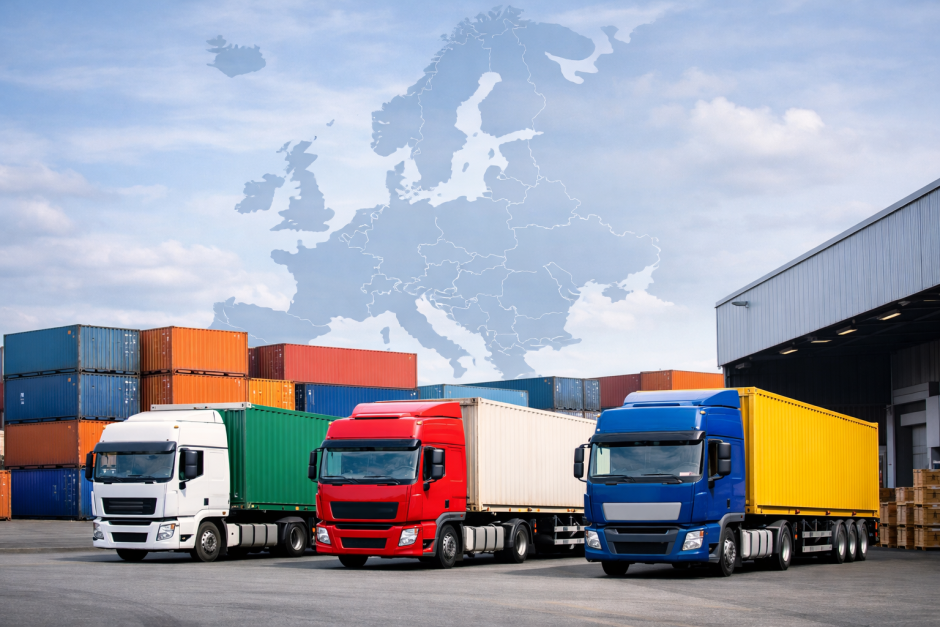
With the development of international trade and logistics, businesses are constantly seeking ways to reduce costs, improve efficiency, and speed up deliveries. In this context, consolidation (cargo consolidation) has become one of the most important tools in the logistics sector. Especially for small and medium-sized businesses, consolidation allows them to benefit from international transportation without needing to fill an entire shipment.
In this article, we will cover:
-
What consolidation is,
-
How it works,
-
The role of groupage shipments,
-
How it helps businesses in Europe and beyond,
-
And why consolidation has become an essential part of modern logistics strategy.
What is Consolidation (Cargo Consolidation)?
Consolidation is a logistics process where smaller shipments from different senders are combined into a single shipment and transported together in the same direction.
The concept is based on groupage shipments: multiple companies’ goods can share the same truck, container, or air cargo, with payment only for the space or weight they occupy.
This approach is widely used in Europe, especially for shipments from Germany, France, Italy, Spain, the Netherlands, and Poland.
How Consolidation Works: Step by Step
1. Collection from Multiple Suppliers
Businesses send their goods to a consolidation center (warehouse or hub), often located in major logistics hubs such as:
-
Germany (Frankfurt, Hamburg)
-
France (Paris, Lyon)
-
Italy (Milan)
-
Netherlands (Rotterdam)
2. Sorting and Documentation
Each shipment is registered individually, documents and customs codes are checked, and compliance with international regulations is ensured.
3. Consolidation
Shipments from different senders are combined into one transport unit, forming a groupage shipment.
4. International Transport
The consolidated shipment is transported to the destination country by road, sea, or air.
5. Deconsolidation
At the destination, shipments are separated by recipients and delivered to their final addresses.
Groupage Shipments: Why They Are Effective
Groupage shipments allow businesses to pay only for their share of the cargo rather than the full truck or container.
This is particularly beneficial for companies that:
-
Do not have large-volume orders,
-
Handle diverse products,
-
Frequently import goods from Europe.
For example, a small importer bringing goods from Spain or Belgium can significantly reduce costs by using groupage shipments.
How Consolidation Helps Businesses
1. Significant Cost Savings
With consolidation, businesses:
-
Avoid paying for unused space,
-
Avoid high full-load shipping rates,
-
Gain a more predictable logistics budget.
2. Easier Access to International Markets
Small and medium businesses can import goods from:
-
Germany
-
France
-
Italy
-
Austria
-
Poland
without needing to send full shipments.
3. Flexible Supply
Consolidation enables:
-
Frequent deliveries,
-
Small batch shipments,
-
Quick response to market demand.
4. Risk Reduction
Consolidation is often handled by experienced logistics companies that:
-
Ensure cargo safety,
-
Minimize customs errors,
-
Monitor the entire supply chain.
5. Optimized Logistics Processes
Businesses can focus on core operations while leaving logistics to specialists.
European Countries and Active Consolidation
Europe is one of the most developed regions for consolidation. Especially active are:
-
Germany – industrial and export giant
-
France – wide range of consumer goods
-
Italy – fashion, furniture, food products
-
Netherlands – key European logistics hub
-
Belgium – warehouses and distribution centers
In these countries, consolidation centers operate with highly automated systems, speeding up the formation of groupage shipments.
When Consolidation is the Best Solution
Consolidation is ideal if:
-
Your shipment does not fill a full truck,
-
You want to reduce logistics costs,
-
You work with multiple European suppliers,
-
You need regular imports.
Consolidation vs Full Truck Load (FTL)
| Factor | Consolidation / Groupage Shipments | FTL |
|---|---|---|
| Cost | Low | High |
| Flexibility | High | Low |
| Speed | Medium | High |
| Suitable For | SMBs | Large Business |
In today’s competitive business environment, consolidation has become not only a cost-saving tool but also a strategic growth instrument. Through groupage shipments, businesses can confidently work with European markets, importing from Germany, France, Italy, and other countries without excessive financial burden.
Properly organized consolidation ensures:
-
Predictable logistics,
-
Controlled costs,
-
Sustainable business growth.
Modern business requires not only high-quality products or services but also a flexible and intelligent supply chain. In this context, consolidation is a key part of logistics strategy, particularly for companies working with international partners and importing goods from Europe. Using groupage shipments enables businesses to manage costs efficiently while maintaining stable and predictable deliveries.
In countries like Germany, France, Italy, the Netherlands, and Belgium, consolidation systems have long become standard. Even businesses with small shipment volumes can cooperate with international suppliers without restrictions. This is especially important for growing businesses seeking to expand their markets and remain competitive.
Ultimately, well-organized consolidation is not just a technical solution—it is a long-term investment in business growth, risk reduction, and sustained success in the global market.
